11 Plus Scores: Kent, Buckinghamshire and Local Rules
Grammar school entrance assessment is organised through different local arrangements across England. The score on a child's report may be age-standardised and used against a local qualification rule, while an eventual school offer follows separate admissions criteria. Compare official guidance for the specific authority instead of applying a universal threshold.

Last updated:
First identify the authority and the score report
The term grammar-school entrance test covers grammar school entrance assessments administered under local or consortium arrangements in England. Scores can be age-standardised to account for the fact that children in the same school year can vary in age. The grammar-school entrance test examination guide helps with preparation, while score interpretation begins with the area or consortium issuing the report. The official local scoring guide is essential because different authorities can use different scales and qualification rules.
A Kent Test result
Kent County Council’s published Kent Test results information describes 3 standardised scores, one each for English, mathematics and reasoning, and an aggregate. Its area scores run from 69 to 141, with a highest possible aggregate of 423. For 2026, a grammar school assessment required an aggregate of at least 345 and each area to reach at least 111.
These are rules for the Kent Test and the stated round. The aggregate gives an overall measure while the component minima ensure that performance in every assessed area is considered. If you compare the report with practice papers, preserve each area separately and pay attention to the standardisation method.
Buckinghamshire uses its own calculation
The Buckinghamshire Council marking guide explains that section scores are standardised to account for age, with values ranging from 60 to 170. Its overall Secondary Transfer Test Score uses 50% verbal, 25% mathematical and 25% non-verbal performance. The council’s qualifying level is 121.
Buckinghamshire’s result must therefore be interpreted using the Buckinghamshire calculation. A figure taken from Kent has a different scoring context. Qualification establishes eligibility for consideration for a grammar school place; the subsequent admission process uses school-specific arrangements. Check the school preference and admission criteria after receiving the result.
Make the score useful for preparation
When reading any grammar-school entrance test report, record its assessing authority, component scores, qualification message and available next steps. For a future application, practise the kinds of reasoning tasks used by that particular test provider, and review weaknesses by skill rather than comparing scores from unrelated regions.
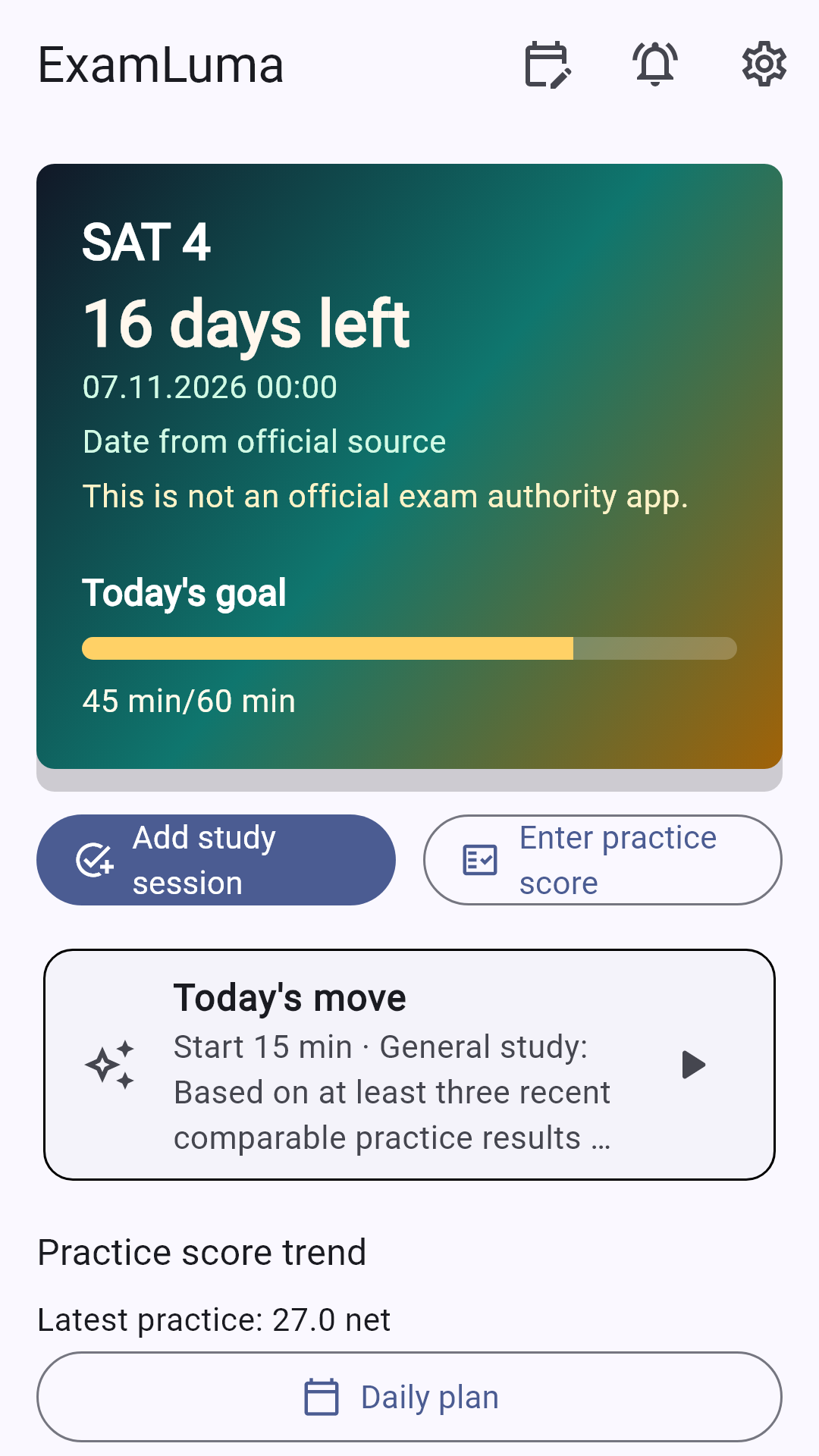
ExamLuma lets you choose the grammar-school entrance test as a study target, track the countdown, set daily study-time goals and use the focus timer. Enter practice counts of correct, wrong and blank answers to see your overall trend and weekly study statistics.
How ExamLuma helps
Keep track of your study plan in ExamLuma. ↗
Set a daily study goal and follow your progress. ↗
Record completed study sessions. ↗
Frequently asked questions
Is there a national eleven-plus passing score?
Grammar school admission testing and scoring arrangements depend on the relevant local authority or consortium.
What does an age-standardised score mean?
The assessment adjusts score interpretation using an age-related comparison process set by the test organiser.
Does qualification mean a school place has been offered?
Qualification is one stage; places are allocated under each school's published oversubscription and admissions rules.
Sources
- Kent County Council: Kent Test scores and thresholds · Kent County Council
- Buckinghamshire: Secondary Transfer Test marking · Buckinghamshire Council