interleaving: Alternate Worked Examples and Problem Solving
Interleaving organizes your study session by alternating between different task modes—specifically pairing worked examples with your own independent problem solving—and mixing related problem types. This structured alternation pushes you to examine how each solution step functions and apply the reasoning immediately on a matching task of your own.

Last updated:
Interleaving structures your practice by mixing task types, and in instructional research from the Institute of Education Sciences, it specifically includes alternating a worked example with a problem that you solve independently.
Imagine you are preparing for physics kinematics questions. Instead of reading several model solutions in a row and saving all problem sets for later, read one complete step-by-step demonstration of a projectile task and immediately solve a parallel projectile problem on your own. As you move from the model to your own work, use self-explanation to state why each kinematic equation fits the given variables. Alternating demonstration and independent execution keeps your focus on the logic behind every step and prepares you to choose the right method when questions appear on your exam.
How ExamLuma helps
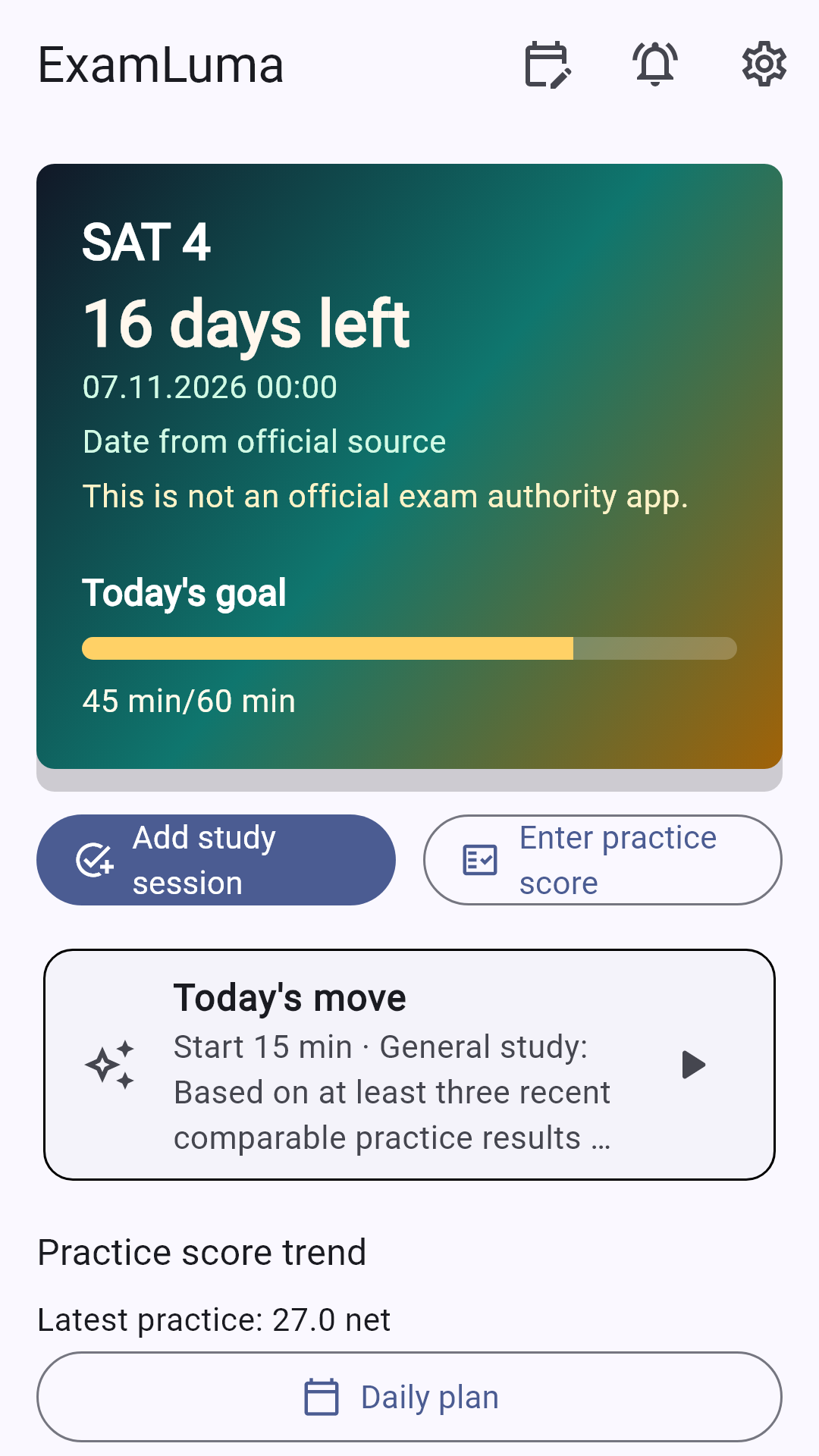
Keep track of your study plan in ExamLuma. ↗
Set a daily study goal and follow your progress. ↗
Record completed study sessions. ↗
Frequently asked questions
How does the IES guide describe alternating tasks in study?
The practice guide specifically recommends alternating worked examples with independent problem solving so you immediately apply what you just examined.
Why is alternating tasks helpful for math and science exams?
Switching from a demonstrated solution to an unsolved problem requires you to actively use the underlying principle rather than copying steps mechanically.
How can I set up an interleaved session at my desk?
Select a small set of problems where each fully explained model solution is followed directly by a similar problem for you to solve alone.
Sources
- Organizing Instruction and Study to Improve Student Learning · Institute of Education Sciences · 2007