spaced practice: Schedule Reviews Across Separate Sessions
Spaced practice is the strategy of returning to learned material across separated study sessions rather than crowding all your review into a single sitting. Spreading your study blocks over time gives you multiple opportunities to reconstruct concepts, check your understanding, and keep earlier course units fresh as exam day approaches.

Last updated:
Spaced practice is a scheduling approach where you return to learned material across separated study sessions over time. The Institute of Education Sciences practice guide recommends spacing learning across multiple sessions so you repeatedly engage with key concepts as your course progresses.
To put this into action for a chemistry unit on equilibrium, study the core principles early in the week, return a few days later to solve a fresh set of problems, and revisit the topic again during a subsequent weekly review. During each return visit, start with retrieval practice by writing out the equilibrium expression rules before looking at your reference sheet. When you design your calendar, combine this distributed schedule with your subject’s exam weighting so foundational topics receive steady, recurring review entries throughout your preparation.
How ExamLuma helps
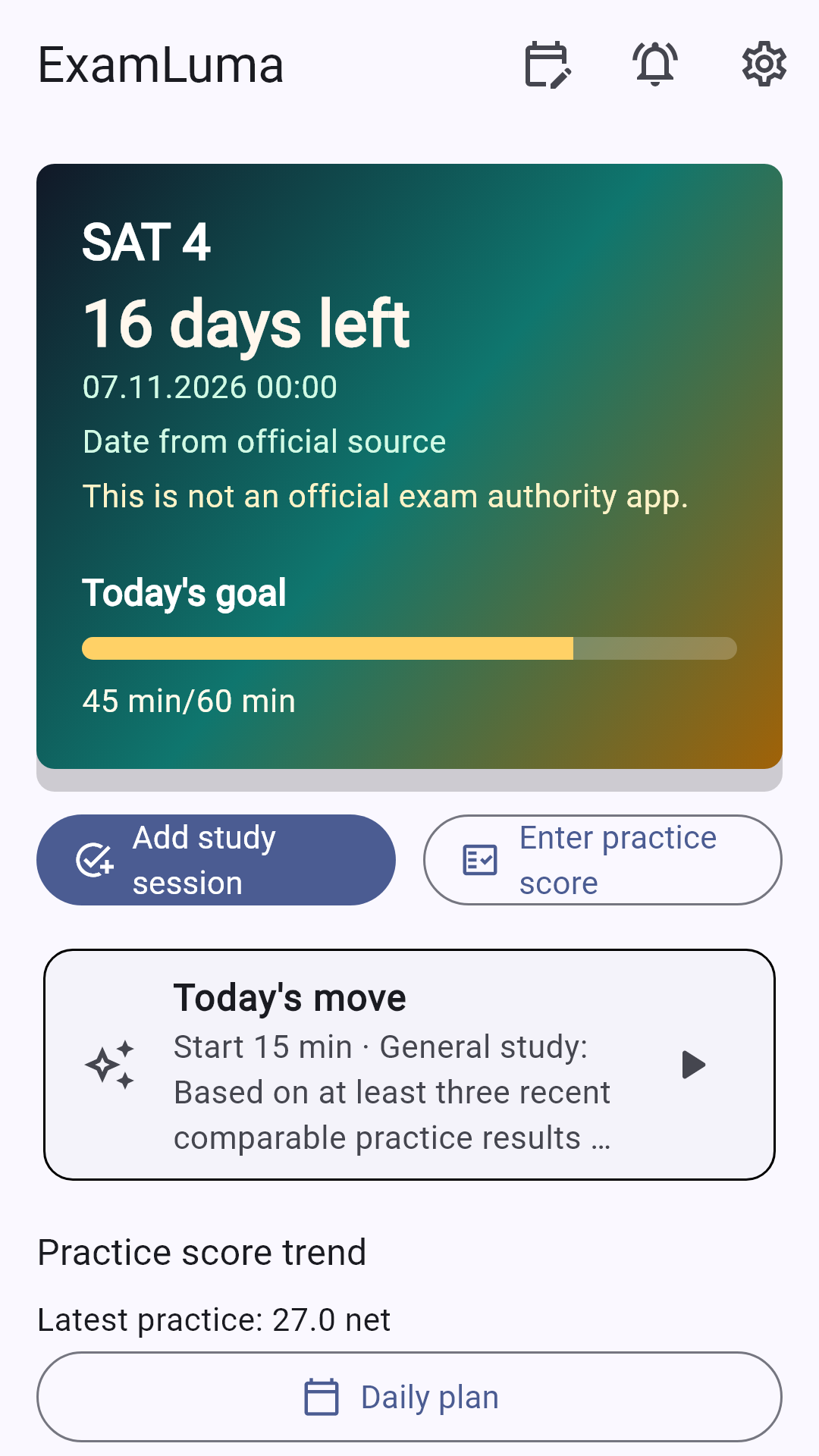
Keep track of your study plan in ExamLuma. ↗
Set a daily study goal and follow your progress. ↗
Record completed study sessions. ↗
Frequently asked questions
How do I start using spaced practice in my weekly calendar?
Schedule an initial study block for a new topic, then place short follow-up review blocks for that same topic on separate days.
Is there one fixed interval that everyone must follow?
Research supports spreading sessions across separated times, and you can adjust the exact days to fit your syllabus and exam calendar.
What should I do during a follow-up review session?
Use closed-book recall questions or fresh problems to test what you still remember before reviewing your summary notes.
Sources
- Organizing Instruction and Study to Improve Student Learning · Institute of Education Sciences · 2007