How to spot the mistake behind a GRE General Test answer
A wrong answer tells you where to look. Your scratch work tells you what to change. Trace a verbal answer back to a word in the passage, test a quantitative comparison against its conditions, and check an Issue essay example against the claim it is supposed to support.

Last updated:
Cover the explanation for a missed question and look at the point where you committed to your answer. Did you add an idea to the passage, assume something about a variable, or write an example that barely touched your argument? Each error calls for a different next attempt.
Which word changed the verbal claim?
Suppose a passage says that after a library started opening on Sundays, the weekend visit count rose. An answer says that Sunday hours brought new readers to the library. That sounds reasonable. Yet the passage counts visits. Some regular readers could have switched from Friday to Sunday. Write “visits” above “new readers” and ask what additional information would let the author move from the former to the latter. This gives you a precise reason to cross out the answer.
The same attention to meaning helps with text completion. Cover the choices and sketch the missing idea in ordinary language. If a sentence starts by saying a plan looked simple and continues with “in practice, however,” you have a reason to expect a complication. Test each option against that turn. A word that fits the subject of planning may still send the sentence in the wrong direction.
In sentence equivalence, read the completed sentence aloud with each of your proposed choices. Do both sentences say roughly the same thing, and does each fit the context? A familiar pair of near-synonyms can fail the context check together. ETS distinguishes these task types in its Verbal Reasoning overview.
Try to overturn a quantitative comparison
Imagine a question comparing the absolute value of an integer with the integer itself. If you picture a positive integer, the quantities are equal. Try a negative integer and its absolute value is larger than the integer. Both cases obey the stated condition. If you gave a single relationship as your answer, underline the word integer and jot down the case you overlooked.
Next, change the condition to “negative integer.” You now need a reason that covers every permitted value. The absolute value of any negative integer is positive, so it always exceeds the original integer. That statement explains the relationship across the entire allowed range. Practicing these versions together teaches you when a counterexample settles a question and when you still need a general argument. The ETS Quantitative Reasoning guide explains the possible relationships in a quantitative comparison.
When reviewing a word problem, add a label to every number you copied. If you treated a price after a discount as the original price, the calculator can return an accurate answer to the wrong question. Go back to the first mislabeled amount. Redoing the arithmetic alone would leave your next setup vulnerable to the same mistake.
What does your Issue essay example establish?
Imagine a prompt about whether a university should keep its library open later. “Students need the library” gives a reader very little to work with. A commuter who stays on campus after an evening lab to consult a reference collection gives you a specific case. Explain what the later closing time would make possible. Then consider what would change if most of the materials were already available remotely.
Return to the precise instructions for your chosen ETS Issue prompt. An example about access may support extending the hours under certain conditions. A broader claim about what every university should do still needs an argument about institutions with different needs. Adjust the scope of the claim or develop the missing comparison before polishing transitions.
Sample plan
Weeks 1–4. Keep a list of changes in meaning that fooled you in reading passages. On a new problem, jot down the group the author studied and check whether an answer quietly expands that group.
Weeks 5–8. With a quantitative comparison, circle the domain before you calculate. Pick values from opposite sides of a boundary if the conditions allow it. Then narrow the domain and work out whether the relationship is now fixed.
Weeks 9–12. Take a position on an Issue prompt. Choose a case where your position holds and a case where you would qualify it. Read the prompt again and keep the contrast if it helps answer the specific directions.
Final 4–8 weeks. Mix the tasks so the question itself has to remind you which check to use. For a 15-minute review, spend 5 minutes solving a fresh comparison, 5 minutes looking for a case that overturns your answer, and 5 minutes writing down the condition that settled it. Keep the original calculation for comparison.
Check whether the repair holds
Give each entry in your notebook a concrete test. For the library passage, look for a fresh inference question that changes who or what is being counted. For the comparison, find a problem with a different domain restriction. For the essay, hand someone the paragraph and ask them to state the claim your example supports. You can borrow the SAT practice-test review routine of revisiting missed or guessed answers and apply it to the GRE tasks that keep catching you.
Close the notebook before you try the fresh task. Afterward, compare your reasoning with the earlier attempt. If the same assumption slips back in, put that decision into your weekly GRE plan as a task you can finish, such as checking which values a variable allows before comparing expressions.
How ExamLuma helps
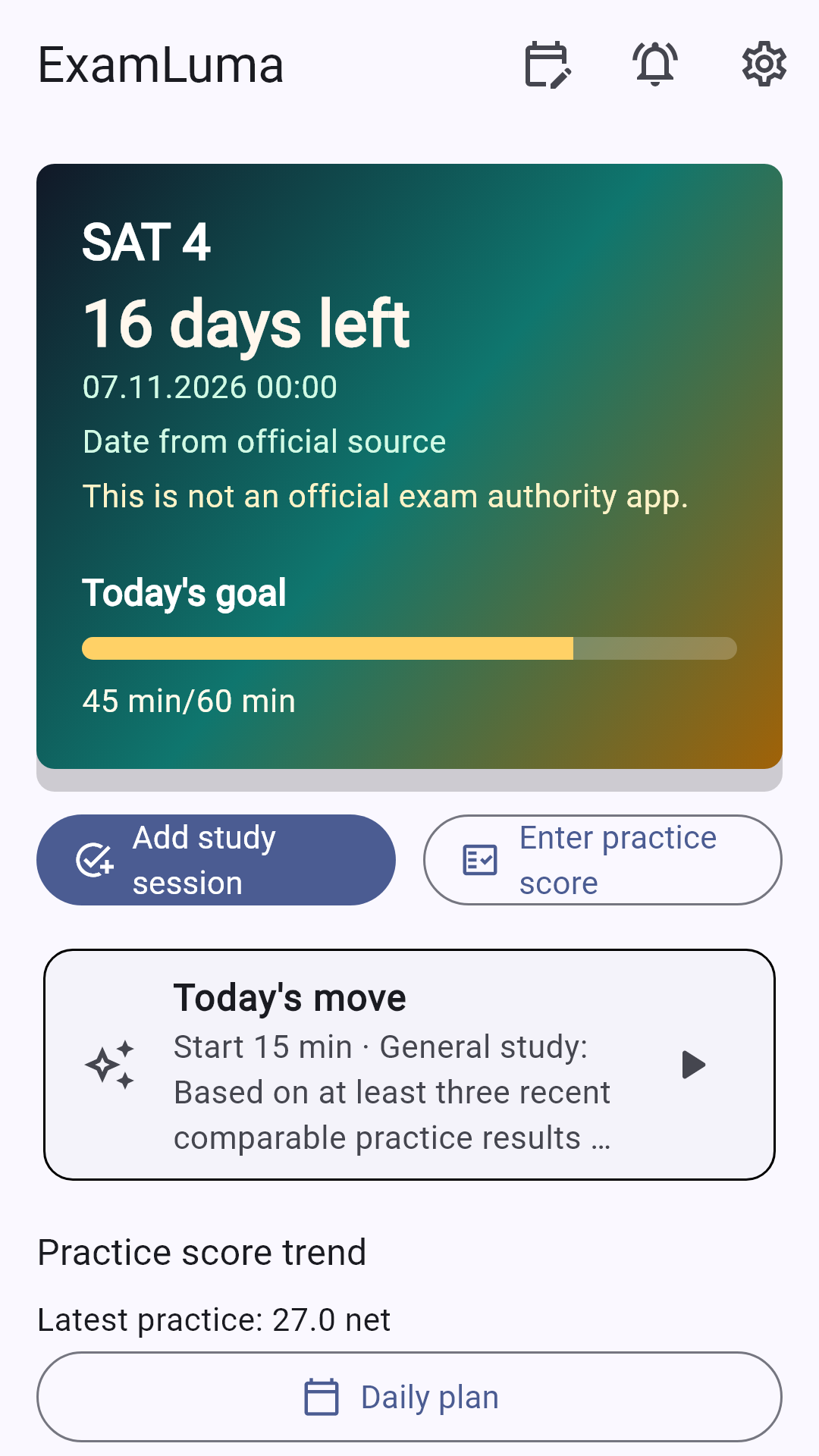
Keep track of your study plan in ExamLuma. ↗
Set a daily study goal and follow your progress. ↗
Record completed study sessions. ↗
Frequently asked questions
How should I review a verbal answer I guessed correctly?
Point to the phrase that supports it and explain what rules out the closest alternative. If either explanation is shaky, keep the item in your review pile.
What should I do after finding a counterexample in Quant?
Compare its result with another permitted case. If the relationship changes, describe which condition allows the change. If it stays the same, keep testing or look for a proof.
How can I tell whether my essay example supports my argument?
Write the claim beside the example. Add a sentence explaining how the event you describe would support the claim. If the explanation changes the claim, revise the paragraph.
Sources