How to Review a Bluebook SAT Practice Test by Skill
Open your completed Bluebook test in College Board My Practice and inspect every missed, slow, and guessed question before starting another practice set. Sort each item by its official Reading and Writing or Math domain, read the explanations for every answer choice, and turn your error notes into focused practice sessions for the coming week.
Last updated:
Open your completed Bluebook test in College Board’s My Practice right after scoring and tag every missed, guessed, and slow question before you touch another practice set. A score report helps you improve when you examine why each error happened and turn those findings into targeted study blocks, as outlined in College Board’s study plan guide.
How to break down your Bluebook results
Inspect every choice in My Practice
Open your Bluebook results in My Practice and compare the question list with your own notes about guesses and slow solutions. Mark these items in your review notebook alongside incorrect answers. Read the explanation for the right answer and the explanations for the wrong choices you considered. When you write down why a distractor looked appealing, you train yourself to recognize that trap during your next test.
Group mistakes by official domain and cause
Label each question in your log with its official content area so your follow-up practice stays specific. For Reading and Writing, sort items into Information and Ideas, Craft and Structure, Expression of Ideas, or Standard English Conventions. For SAT Math, group questions under Algebra, Advanced Math, Problem-Solving and Data Analysis, or Geometry and Trigonometry. Next to the domain, note whether the mistake came from a concept gap, a misread prompt, a rushed setup, or a punctuation rule slip.
Pair worked examples with spaced retrieval
Follow the recommendations in the IES study guide by alternating worked examples with independent problem solving and spacing your review across several days. Study a complete solution to see how the equation or grammar structure works, solve a parallel problem on your own, and schedule a short retrieval quiz later in the week to confirm the skill sticks.
Sample plan: 1 practice week
Use this filled review log and 7-day follow-up schedule to turn 1 Bluebook practice test into targeted daily sessions. Once you finish logging your missed items, you can organize your recurring subject blocks in a weekly study plan that balances review with new practice.
Filled error-log entries
| Item & status | Section & domain | What went wrong | Fix & follow-up task |
|---|---|---|---|
| Comma splice (Incorrect) | Reading and Writing: Standard English Conventions | Joined 2 independent clauses with a comma before a transition word instead of using a semicolon. | Write out the boundary rule for independent clauses and complete 8 punctuation items in 15 minutes. |
| Linear system (Correct, guessed) | Math: Algebra | Plugged in answer choices on a system of linear equations because the word-problem rate setup felt unclear. | Translate each sentence into a variable expression first, then solve 6 linear-system word problems in 20 minutes. |
| Quadratic factoring (Incorrect) | Math: Advanced Math | Dropped the negative sign when factoring a quadratic expression under time pressure. | Check the middle term by expanding factors on scratch paper and complete 6 quadratic factoring problems in 18 minutes. |
7-day follow-up schedule
- Monday (45 minutes): Review all Math errors and guessed items from Module 1 and Module 2 in My Practice (25 minutes); re-solve 5 missed Algebra and Advanced Math questions on fresh scratch paper (20 minutes).
- Tuesday (45 minutes): Review all Reading and Writing errors and flagged guesses in My Practice (25 minutes); write 1-sentence rules for 4 missed Standard English Conventions items (20 minutes).
- Wednesday (40 minutes): Study 2 worked examples of linear-equation word problems, then solve 8 new Algebra setup problems independently (25 minutes); drill 6 clause-boundary punctuation questions (15 minutes).
- Thursday (40 minutes): Study 2 worked examples of quadratic and exponential equations, then complete 6 Advanced Math practice items (25 minutes); analyze 4 Craft and Structure vocabulary-in-context questions (15 minutes).
- Friday (35 minutes): Take a closed-note retrieval quiz with 6 Algebra and Advanced Math problems and 6 Standard English Conventions questions drawn from Monday and Tuesday error topics (25 minutes); check explanations for any miss (10 minutes).
- Saturday (50 minutes): Complete 1 timed 20-minute Reading and Writing practice set and 1 timed 20-minute Math practice set focusing on your logged domains; spend 10 minutes tagging any slow or uncertain answers.
- Sunday (25 minutes): Re-work 4 questions from your error log cleanly from start to finish (15 minutes) and pick the top 2 domains for next week’s study blocks (10 minutes).
Track your SAT review in ExamLuma
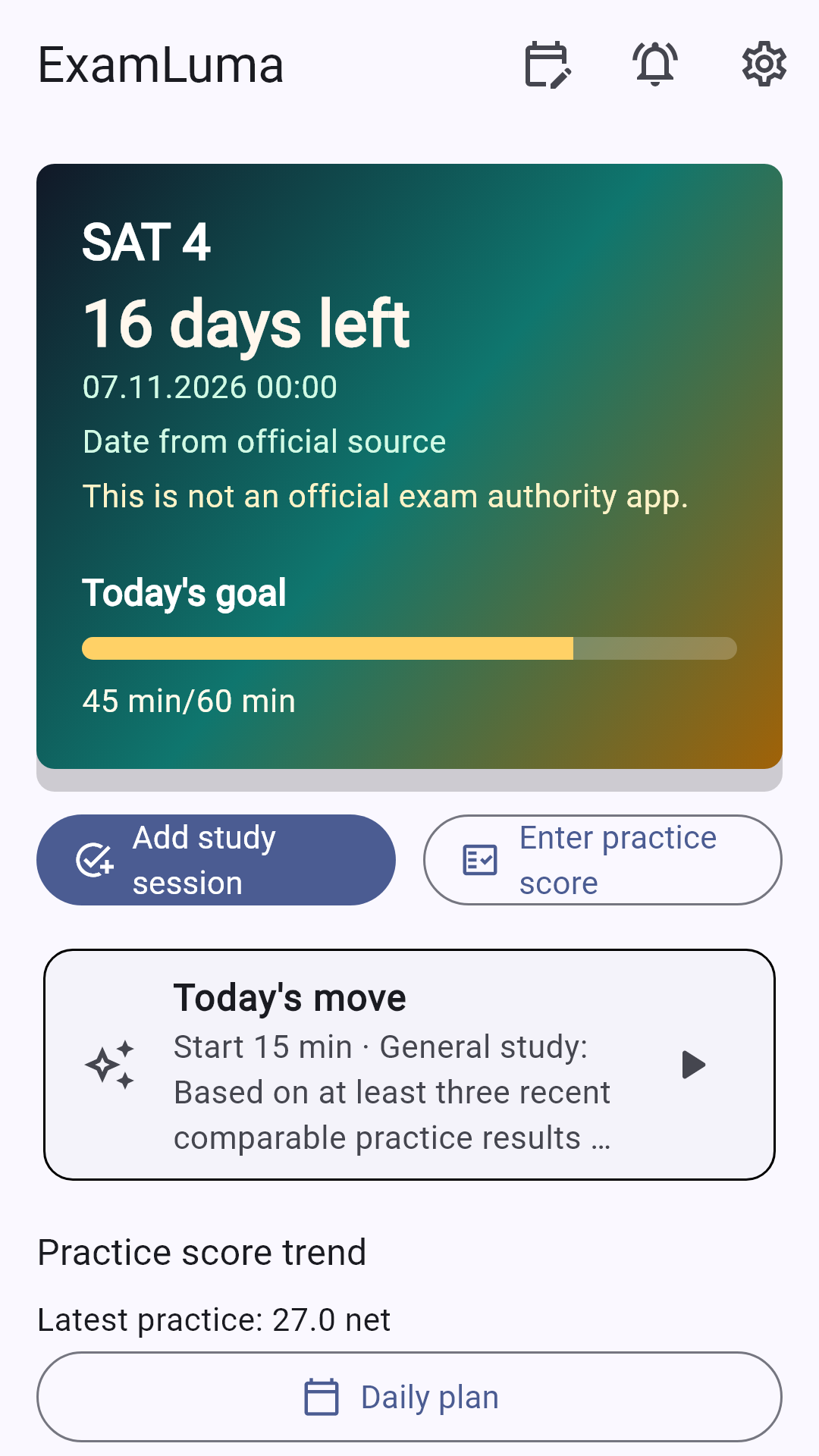
After you finish your post-test analysis for the SAT, open ExamLuma to keep your follow-up study blocks consistent. Set your daily study goal, start a focus session while you drill your target Math or Reading and Writing skills, and let the completed time add directly to that subject’s study log. Record your practice test results after each full sitting and check your weekly statistics to see how your study time and scores progress side by side.
How ExamLuma helps
Keep track of your study plan in ExamLuma. ↗
Set a daily study goal and follow your progress. ↗
Record completed study sessions. ↗
Frequently asked questions
Why should you review questions you answered correctly on a practice test?
A lucky guess or a slow solution hides a real skill gap that can cost you points on a harder question later. Reviewing every flagged or uncertain correct answer in My Practice shows whether your reasoning matched the actual concept or relied on chance.
How do you use answer explanations effectively in My Practice?
Read the explanation for the correct choice alongside the explanations for the distractor choices. Naming the exact trap that pulled you toward a wrong option helps you spot that same pattern on future Reading and Writing or Math questions.
What should go into your practice test error log?
Record the test section, the specific skill domain, the exact reason you missed or hesitated on the problem, and the concrete rule or mathematical setup needed to solve it cleanly next time.
When should you re-solve the questions you missed?
Work through a fresh example of the same skill right after reading the explanation, then revisit similar practice problems later in the week so you retrieve the method from memory rather than repeating steps you just read.
Sources
- My Practice 101 · College Board
- Build Your SAT Suite Study Plan · College Board
- Organizing Instruction and Study to Improve Student Learning · Institute of Education Sciences · 2007
- The Reading and Writing Section · College Board
- The Math Section · College Board