A Level Grades: Boundaries, A* and AS Results
A level results award a grade for each subject, while university offers may require a particular combination. Exam boards mark assessed work and set boundaries using information about paper difficulty and established standards. England's A level and AS qualifications have different grading scales. Check the qualification, subject and awarding body before comparing your result with an offer.

Last updated:
Start with the qualification and subject
An A level result reflects the grade you earned in a particular subject. Your grades in biology, chemistry and mathematics may therefore communicate different strengths, even when you took all the examinations in the same series. Universities and other organisations can specify combinations of grades and particular subjects in their entry conditions.
Ofqual’s official qualification glossary sets out the A level grade range in England as A*, A, B, C, D and E, with U denoting an unclassified result. AS qualifications have their own scale from A to E, with U for unclassified. That distinction matters when comparing a standalone AS outcome with an A level result. The grade you see should always be read in the context of the qualification awarded.
How boundaries turn marks into grades
Ofqual’s guide to grading describes how examiners mark scripts against established schemes and how awarding bodies use performance data and senior examiner judgement to set boundaries. This is designed to keep the standard required for a given grade comparable across exam series.
A raw mark is the result of scoring individual responses, and a boundary determines how those marks correspond to the awarded grade. The boundary can move as paper difficulty changes. A practice percentage taken from a past paper is therefore most useful when paired with the boundary information for that awarding body and series. When reviewing an essay, a calculation or an extended written response, look at how the mark scheme credits the different elements.
Understand the role of different components
A level subjects can use different assessment arrangements, so the marks from individual papers or assessed components contribute according to the subject specification. Ofqual’s qualification conditions set a regulatory framework for awarding bodies in England, while the precise components and their weighting are established in the subject qualification.
Before estimating a result from practice, locate the relevant syllabus and assessment weighting. Use the correct exam board and specification: even subjects with the same name can be assessed through different paper combinations. A percentage from a class test, a mock paper and an official examination represent different contexts, so keep each in its proper place.
Connecting grades with university offers
Read any course offer literally, including named subjects or alternative qualifications. An A level grade may be recognised for entry, scholarship consideration or another purpose according to the receiving organisation’s conditions. If a predicted grade is used in an application, distinguish it from an awarded result and revisit the plan when your official grades arrive.
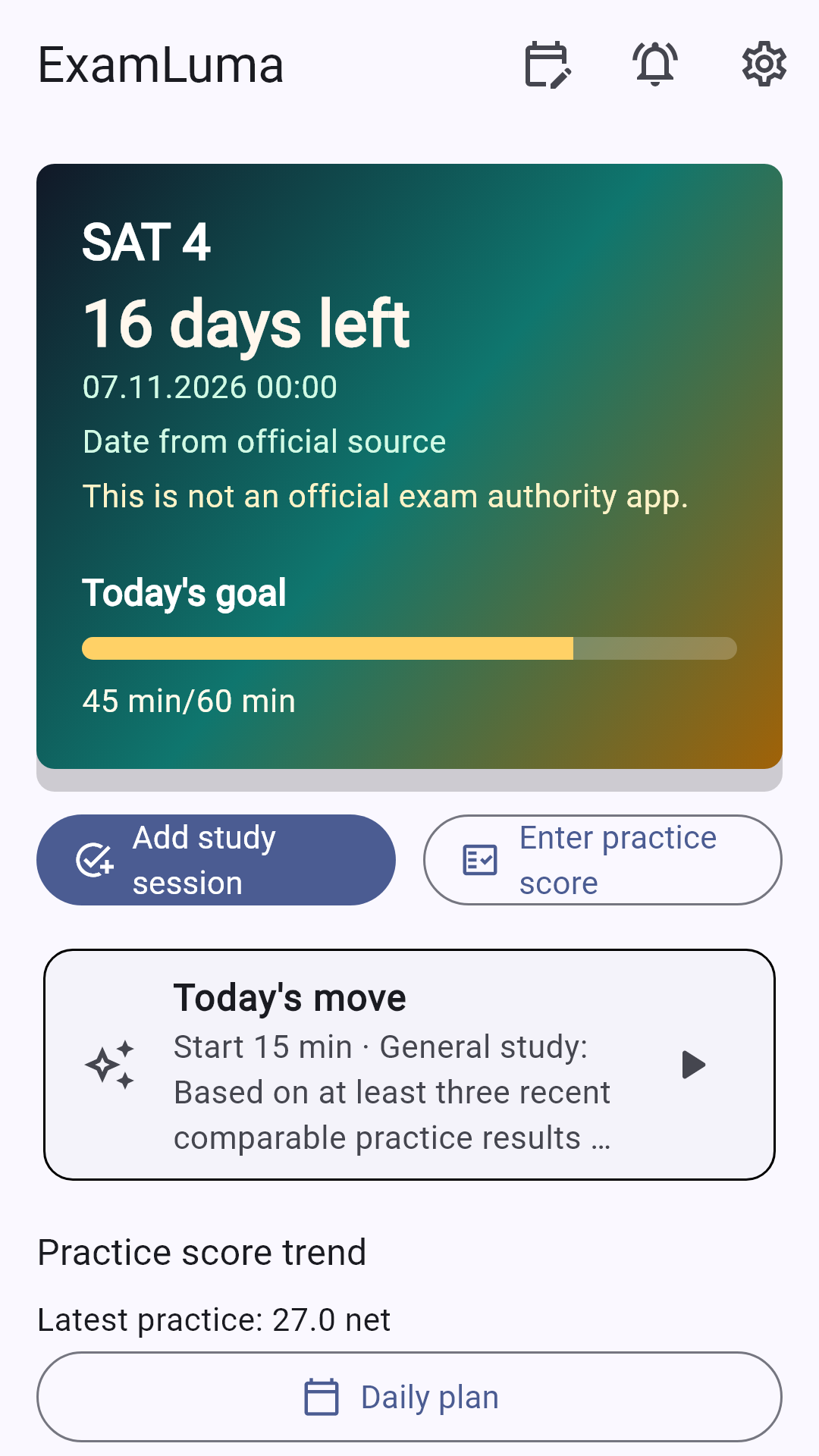
The A level revision guide can help you turn weaker components into clearly defined study tasks. In ExamLuma, select A levels, track your countdown and daily study-time goal, run the focus timer, and enter your correct, wrong and blank practice counts. Your overall practice trend and weekly study statistics can then help you distribute revision across subjects.
How ExamLuma helps
Keep track of your study plan in ExamLuma. ↗
Set a daily study goal and follow your progress. ↗
Record completed study sessions. ↗
Frequently asked questions
What is the difference between A level and AS grading?
A level qualifications include the top A* grade, whereas the separate AS qualification uses grades beginning at A.
Do raw marks map to the same letter grade every year?
Awarding bodies set grade boundaries for each exam series to maintain appropriate standards across papers of differing difficulty.
How do university offers use A level results?
Offers often state required grades in specified subjects or a grade combination; the receiving institution sets its admissions conditions.
Sources