South Korea CSAT score reports explained
South Korea's CSAT reports different indicators according to the subject. Korean language, mathematics and inquiry subjects show a standard score, percentile and grade. English, Korean History and certain other subjects use grade reporting. Understanding the reporting method of each subject helps you compare your profile with university admission plans.

Last updated:
A Korean College Scholastic Ability Test result, widely known as the CSAT or Suneung, is a collection of subject outcomes rather than a single college admission verdict. The CSAT examination overview introduces the subject structure. To understand a score report, start with the subject names and the kind of score displayed for each one. A standard score, a percentile and a grade serve different purposes.
Standard scores describe relative performance
The Korean Ministry of Education’s score-report explanation identifies Korean language, Mathematics and inquiry subjects as areas reporting a standard score, percentile and grade. The standard score places performance into the examination population’s score distribution. It therefore carries information beyond the number of marks obtained from correct answers on a practice paper.
A percentile expresses relative position among candidates in the appropriate subject group. Candidates often use that indicator when deciding which results strengthen their application profile. The grade summarises the subject’s classification into a reporting band. Keep all these fields together because a strong result in one subject may be represented differently from strength in another.
Absolute-assessment subjects use grades
According to the same Korean government explanation, English, Korean History, Second Foreign Language and Classical Chinese or Hanja are reported through grades under their absolute-assessment arrangements. Reading these grades as if they were percentiles would mix different reporting systems. Check the category on the official report before applying a university’s conversion table.
The official KICE 2026 academic-year scoring announcement also supplies subject-specific distributions to help interpret reported grades and standard scores for that cohort. These historical distributions help you understand the cohort, while each university sets the admission requirements for its programmes.
The Korea Institute for Curriculum and Evaluation provides the examination’s official reporting context. For university applications, consult each institution’s admissions plan to find which subjects count, the treatment of particular grades and whether other evaluation components apply. The way the university uses a grade is a separate decision from the examination authority’s reporting rule.
Keep practice records in the right category
Raw practice marks are useful for understanding recurring mistakes. A Korean language error might arise from interpreting the logical relationship between passages. A mathematics mistake could concern a setup assumption or a calculation. For an inquiry subject, distinguish gaps in knowledge from misread data. These categories give you a concrete revision plan while the official CSAT report indicates where your performance stands.
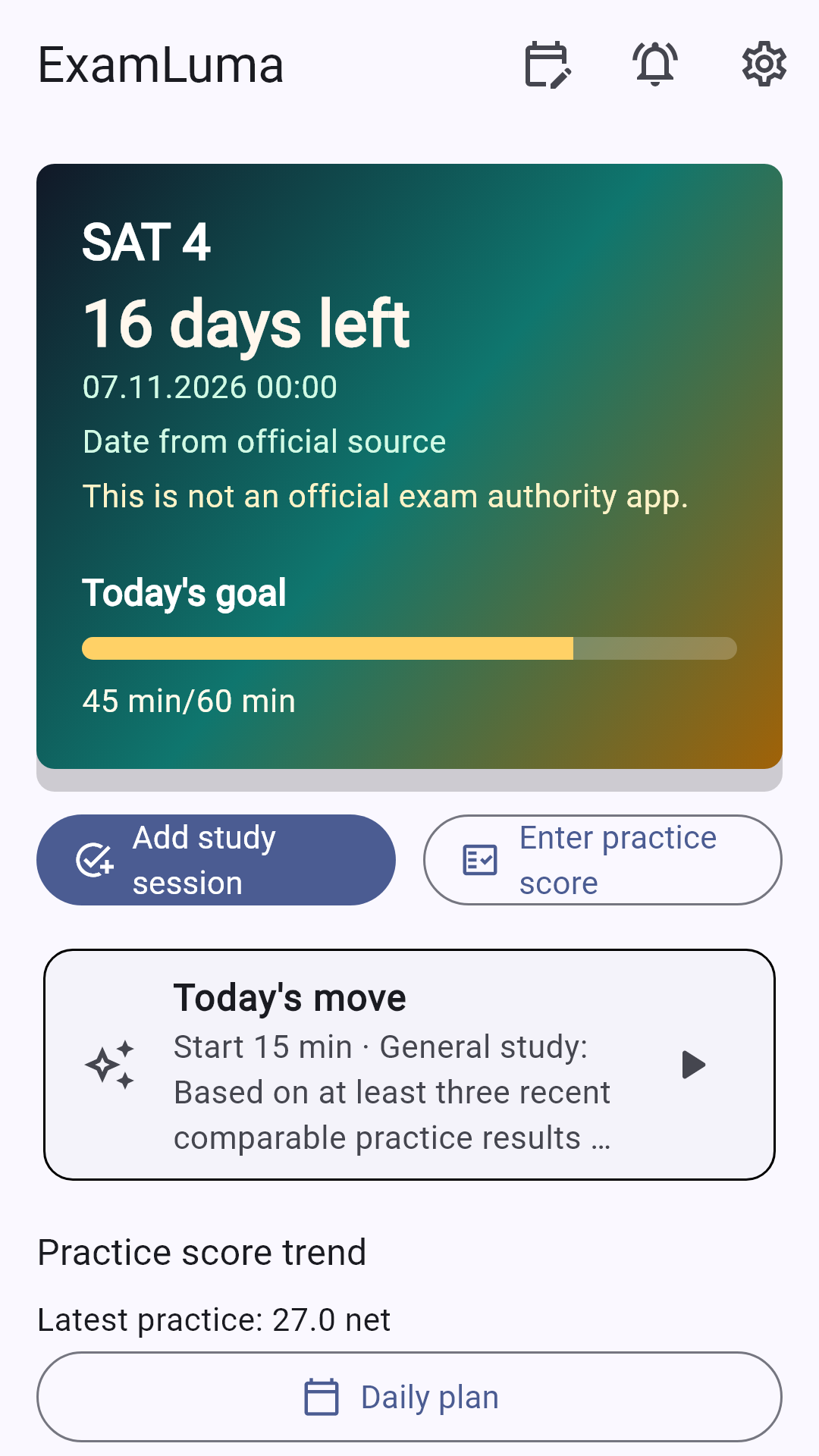
In ExamLuma you can choose CSAT as your target, set a daily study-time goal, follow the countdown and use a focus timer. Record practice results yourself to review the overall trend and weekly study statistics, while keeping official standard scores and university policies in separate application notes.
How ExamLuma helps
Keep track of your study plan in ExamLuma. ↗
Set a daily study goal and follow your progress. ↗
Record completed study sessions. ↗
Frequently asked questions
How does a CSAT standard score differ from a raw mark?
The standard score reflects performance in the tested population and is reported using the examination authority's calculation.
Which sections show percentile ranks?
Korean language, mathematics and inquiry subjects include percentile ranks alongside standard scores and grades.
Who decides how CSAT grades count for admission?
Universities publish their own methods for using the official subject results and any other required selection factors.
Sources
- Korean Ministry of Education CSAT score-report explanation · Ministry of Education, Republic of Korea
- Korea Institute for Curriculum and Evaluation CSAT · Korea Institute for Curriculum and Evaluation
- Official 2026 academic-year CSAT scoring-results announcement · Korea Institute for Curriculum and Evaluation / Republic of Korea