NSW HSC Marks, Bands and School Assessment
The NSW Higher School Certificate reports performance for individual courses rather than one overall exam number. Learn how the assessment mark and external exam mark contribute to the reported course mark, how NESA's performance bands work, and why university selection ranks are calculated separately.

Last updated:
The HSC results statement is an account of achievement in each NSW course. It presents individual NSW course results for separate interpretation. If you need an outline of the qualification, start with the HSC exam guide. When interpreting results, read the three reported mark types and the relevant performance band together.
Understand what goes into the course mark
For most courses, NESA explains that school-based assessment and the HSC examination each contribute 50% to the final result. The assessment mark appearing on the result has been moderated, so it can differ from the raw school task average. This is why adding your class marks using a raw class total instead of the official moderation process can differ from the final course number.
The NESA scoring guidance says the HSC mark is the average of the aligned examination mark and moderated assessment mark, with half marks rounded up. The raw examination mark is also aligned to achievement standards. If a result looks surprising, distinguish the moderation step from the external paper before asking the school or authority about it.
Read the performance band as a standard
For standard two-unit courses, NESA’s official bands put Band 6 at 90–100, Band 5 at 80–89, Band 4 at 70–79, Band 3 at 60–69, Band 2 at 50–59, and Band 1 at 0–49. The band describes the achievement shown, an achievement standard rather than a cohort percentile rank. Extension courses use their own band structure.
A band is useful when you read its description and connect it with course feedback. It describes demonstrated achievement rather than counting exam errors, because alignment occurs before the reporting scale is assigned. Avoid copying raw cut-off tables from an old practice booklet into a current result record.
Recognise exceptions and separate the ATAR
The current NESA results rules describe optional-examination courses that can report an exam-based HSC mark instead of the usual averaged mark. Life Skills results use an outcome profile. Check your course type before treating an absent assessment column as missing data.
NESA explicitly distinguishes HSC results from the ATAR. University admission ranks are calculated through a different process. Keep the HSC mark, subject band and any admission rank in separate records, then check each programme’s prerequisites.
Turn the result into a concrete revision task
Use examiner comments and school feedback to identify the first step that went wrong in a response. Revise a passage inference, mathematical setup or practical method, and test the improvement on new material. A targeted task is more useful than a vague instruction to ‘raise the whole HSC score’.
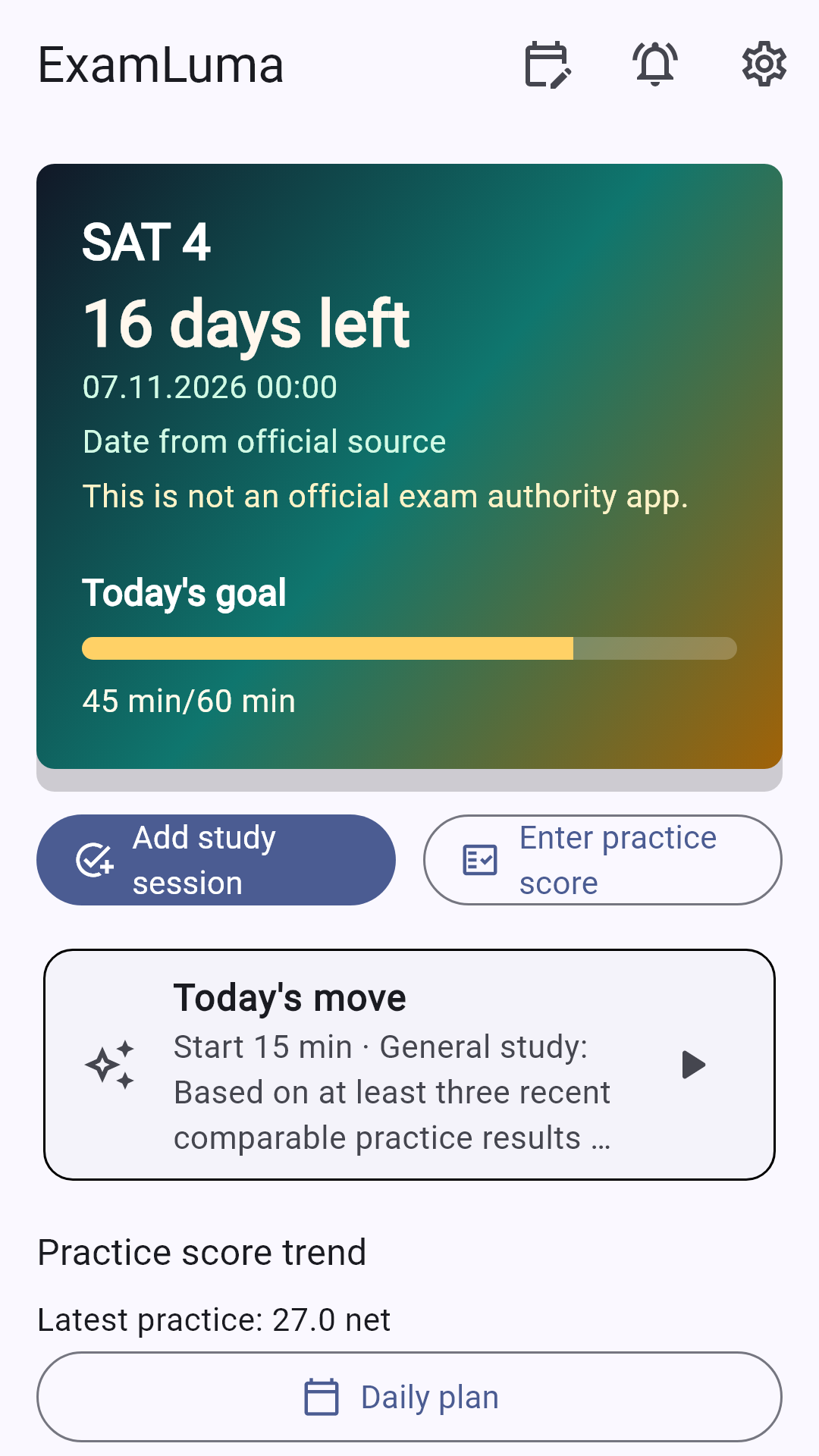
ExamLuma lets you select HSC as your target, follow the countdown, set a daily time goal and use a focus timer. Enter correct, wrong and blank practice counts yourself to follow overall trends and weekly study statistics.
How ExamLuma helps
Keep track of your study plan in ExamLuma. ↗
Set a daily study goal and follow your progress. ↗
Record completed study sessions. ↗
Frequently asked questions
Is the reported assessment mark the same as my raw school mark?
The reported result follows NESA moderation, so it can differ from the raw school total.
Does the HSC have one total score?
Results are recorded by course; the ATAR is calculated separately for university admissions.
Does the same formula apply to every HSC course?
Optional-examination and Life Skills courses have different reporting rules.
Sources
- Understanding your HSC results · NSW Education Standards Authority
- Determining HSC results · NSW Education Standards Authority
- 2026 HSC Guide to Results · NSW Education Standards Authority