Singapore PSLE Achievement Levels and Total Score
Singapore's Primary School Leaving Examination reports Achievement Levels for individual subjects and combines them into a total used for secondary school placement. Lower Achievement Level numbers indicate stronger subject performance. Learn how the total is formed and why the placement result should be read alongside the current school-choice process.

Last updated:
A PSLE statement is intended to help families understand a child’s subject achievement and the next stage of schooling. The PSLE exam overview introduces the subjects and preparation. For the score itself, start with the Achievement Level beside each subject, then read the overall total as an outcome used for secondary school placement.
Read an Achievement Level for each subject
The Singapore Examinations and Assessment Board’s grading explanation uses eight Achievement Levels, from AL1 to AL8. The lower AL values represent stronger performance against the subject’s achievement standard. They reflect subject performance in broad bands, making it possible to discuss an area that needs practice while keeping a single raw mark in context.
Write the AL beside the subject name. A child’s strengths may vary across languages, mathematics and science, so a total alone gives less useful learning feedback than the individual components.
Understand how the overall result is created
According to the SEAB PSLE guide, the overall score adds the achievement levels across four subjects and lies between 4 and 32, with 4 representing the stronger end of the reporting scale. This reverses the intuition many people bring from percentage-based school marks: here a smaller total describes stronger overall achievement.
The Singapore Ministry of Education’s scoring guide explains that the sum includes Standard or Foundation subject outcomes. Check the official treatment of the child’s subject level when comparing results or using any school-choice information.
Place the score in its educational context
SEAB’s current statement describes the PSLE as a placement examination using AL1–AL8 subject bands instead of an overall pass/fail decision. The result helps identify a suitable secondary education programme. School allocation also follows the published choices and procedures for the relevant intake.
When considering school options, use current official school information and keep previous intake ranges in context. A historical posting score tells you about prior selection, while the child’s reported subject ALs remain the enduring description of exam performance.
Make preparation feedback constructive
Read subject-level feedback together with completed practice. For a mathematics task, identify the specific type of reasoning that needed a correction. For reading, discuss which sentence supplied the answer and how the child inferred it. The aim is to practise a learnable step and show improvement on new material.
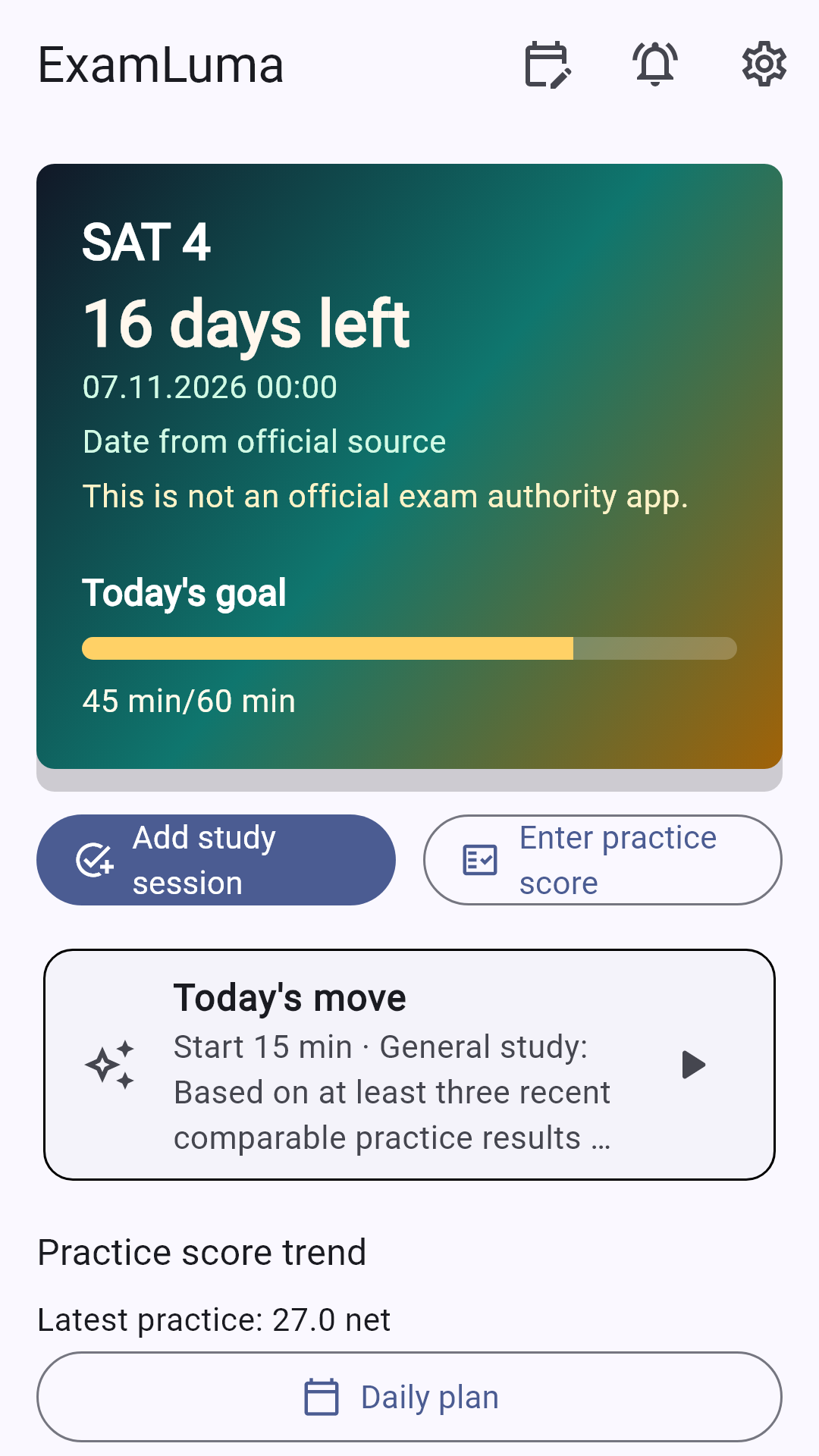
In ExamLuma, choose PSLE as the target, use the countdown, set a manageable daily study-time goal and run the focus timer for a subject task. A parent or learner can enter correct, wrong and blank practice counts manually and use the overall trend and weekly statistics to guide the next review.
How ExamLuma helps
Keep track of your study plan in ExamLuma. ↗
Set a daily study goal and follow your progress. ↗
Record completed study sessions. ↗
Frequently asked questions
Which PSLE subject Achievement Level is strongest?
The first achievement band describes the strongest performance; higher bands describe progressively different achievement.
How is a PSLE score formed?
The subject Achievement Levels are added to make the total used for secondary school posting.
Does PSLE issue an overall pass or fail classification?
SEAB describes PSLE as a placement examination that guides progression to secondary education.
Sources
- About PSLE · Singapore Examinations and Assessment Board
- National examinations grading · Singapore Examinations and Assessment Board
- MOE PSLE scoring information · Singapore Ministry of Education