United Kingdom
GCSE Revision Plan: Give Each Subject a Clear Task
Exam dates from official calendars, together in one place.
Give GCSE revision a clear starting point by naming the subject, the topic and the task you want to complete. Use practice to find what needs attention, then return to it with a better explanation. This guide helps you organise revision alongside school, homework and the rest of your week.
Last updated:
Upcoming sessions
GCSE
Dates are set per test appointment by the provider
Date from official source ↗Checked:
Past sessions (1)
GCSE 2026
Subjects
- General study
- Practice tests
Choose the task before opening your notes. You could explain why a method works in maths, develop a point about a text or describe the relationship in a science experiment. Give the task a stopping point so that you can recognise completed work. That makes revision easier to organise beside lessons, homework and time at home.
Turn your course topics into actions
The Department for Education publishes GCSE subject-content documents for England, including English, mathematics and science. The documents describe common knowledge, understanding and skills. Use the specification for your own course to organise the topics you study, then turn each topic into an action you can attempt and explain.
“Algebra” becomes “explain how to rearrange the equation and apply the method to a fresh problem”. “English” becomes “choose a quotation and explain how it supports the point”. For a science topic, describe the variables in a practice experiment and explain the relationship shown. Keep the task connected to material from the course you take.
Use a mistake to choose the next step
After checking an answer, identify whether the difficulty came from remembering a concept, interpreting the question or carrying out a method. Explain the step in your own words before attempting fresh practice. Keep useful teacher feedback with the task and use it to improve the next response. A short, specific correction is easier to return to than a page of copied notes.
Sample 8-week plan
Weeks 1–2: give your subjects a place
Reserve 4 weekday blocks of 30 minutes and a 60-minute weekend session. Use Monday for a maths method, Tuesday for an English paragraph, Wednesday for a science concept and Thursday for another subject you take. Use the longer session for difficult homework and practice corrections. Move the subjects around your own school timetable.
Weeks 3–5: revisit recurring difficulties
Begin each block with 10 minutes returning to a previous correction. Then attempt a fresh task on the same idea. For maths, explain the relationship before calculating. For English, connect the quotation to the point. For science, explain what the information supports. Give the longer session to the difficulty that keeps appearing.
Weeks 6–8: connect practice and analysis
Attempt timed work from materials for your course and schedule corrections in the next block. Keep the regular subject pattern and use an additional 30-minute reserve slot for work displaced by school commitments. Choose the following week’s priorities from the attempts you have completed.
Keep tomorrow’s task ready
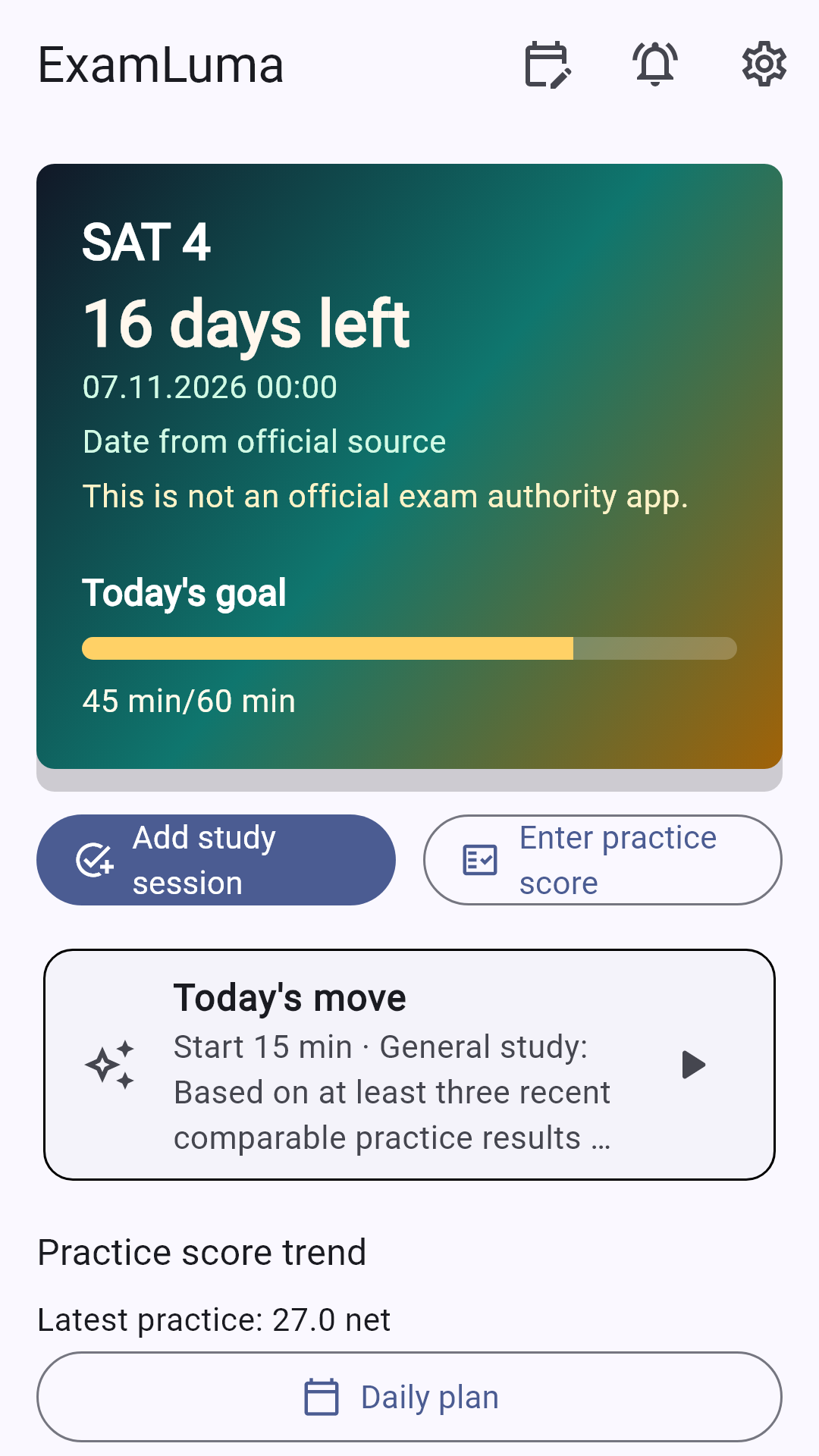
Put the subject, materials and stopping point in your weekly study plan. Select GCSE as your exam in ExamLuma, set a daily study-time goal and run a focus session. Save completed study blocks and use weekly statistics to adjust the routine around lessons and homework. Leave a concrete task ready for your next session.
How ExamLuma helps
Keep track of your study plan in ExamLuma. ↗
Set a daily study goal and follow your progress. ↗
Record completed study sessions. ↗
Frequently asked questions
Where should I start a GCSE revision checklist?
The Department for Education publishes subject-content documents for GCSEs in England. Use the specification for your own course to turn the topics you study into practical revision tasks.
How can I make a maths task specific?
Name the method you want to use, explain why it fits and attempt a fresh problem. After a mistake, identify the step you need to practise again.
How should I balance subjects?
Keep regular space for the subjects you take and give extra attention to a recurring difficulty. Use homework, practice attempts and teacher feedback to choose the next task.
How does ExamLuma support revision?
Select GCSE as your exam, set a daily study-time goal and time focus sessions. Save completed study blocks and use weekly statistics to adjust the following week.
Sources
- GCSE subject content · Department for Education