SAT Study Motivation: Fix an Overloaded Plan
Heavy SAT schedules often stall when your daily list grows faster than your available energy. Simplify your routine by selecting a single finishable task, checking recent practice results to pick your clearest priority, and building a lighter weekly rhythm. Talk with a trusted adult or professional whenever stress persists.
Last updated:
Why overloaded SAT schedules stall
Staring at a crowded checklist of Reading and Writing passages alongside Algebra and Geometry problem sets makes it hard to start. When your plan demands too many chapters in one evening, unfinished tasks pile up and drain your momentum. Resetting your routine starts with cutting the daily load down to what fits your actual energy and calendar.
According to College Board’s study plan guide, effective preparation starts with considering your available time, reviewing practice results, and examining why you missed specific questions so you can choose activities that fit your schedule. Pairing that targeted review with recommendations from the IES study guide—such as spacing study across the week, alternating worked examples with independent problem solving, and using brief retrieval quizzes—keeps sessions active and manageable.
Sample plan: 7-day lighter SAT reset week
1. Pick 1 finishable task from your error notes
Open your recent Bluebook practice results and personal notes to find 1 recurring skill gap. Instead of scheduling an entire domain, assign 1 short block of 25 minutes where you study 2 worked examples and solve 4 independent questions on that exact topic. After you review why each missed question went wrong, map out your next section blocks using our SAT prep guide so your priority topics stay organized.
2. Space short blocks across 7 days
Use this filled 7-day reset schedule to keep daily time budgets light and predictable:
- Monday (25 minutes): Algebra — study 2 worked examples on linear equations in 1 variable, then solve 4 practice items and write down the exact step where any error happened.
- Tuesday (20 minutes): Reading and Writing — complete 6 Standard English Conventions items focusing on boundaries and punctuation, then explain the rule for each answer in your notes.
- Wednesday (25 minutes): Algebra — run a retrieval quiz of 5 linear function questions from memory, then check solutions and rework 1 missed problem.
- Thursday (15 minutes): Rest and light review — read your mistake notes from Monday through Wednesday for 15 minutes and close your books early.
- Friday (25 minutes): Reading and Writing — work through 4 Craft and Structure words-in-context questions and 2 text structure items, noting the clue words in each passage.
- Saturday (30 minutes): Problem-Solving and Data Analysis — alternate 2 worked examples on ratios and percentages with 6 independent practice questions.
- Sunday (15 minutes): Weekly reset — review your completed sessions and lay out your printable weekly study planner for the coming week.
3. Protect rest and talk with people you trust
The NHS student stress guide recommends breaking work into manageable chunks, building relaxation into your routine, and talking openly with friends, family, or a tutor. If coping remains difficult or stress is affecting your daily life, reach out to a trusted adult and speak with a qualified health professional for support.
Track a calmer routine in ExamLuma
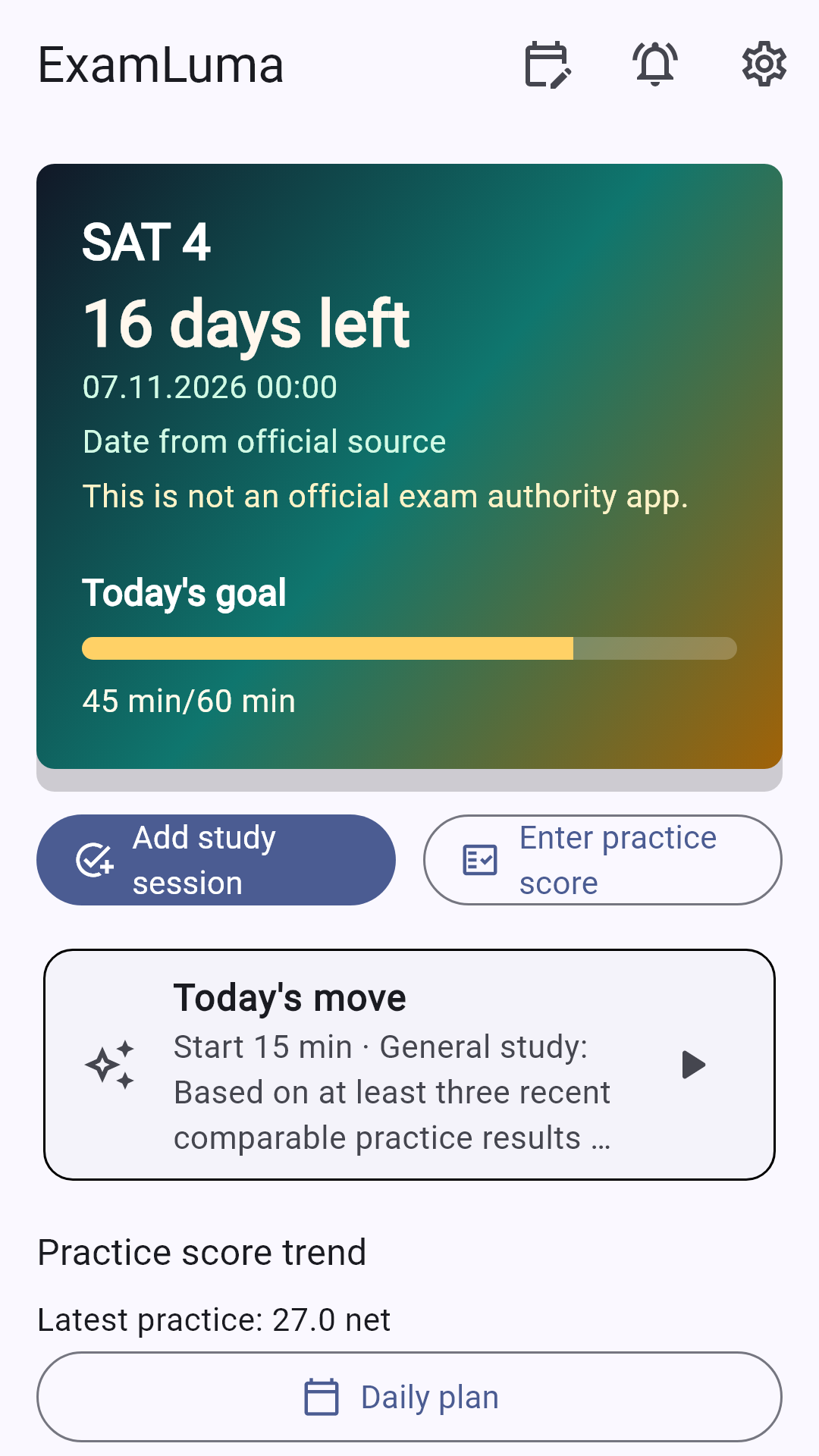
ExamLuma keeps your study plan simple and visible on your phone. Set a comfortable daily study-time goal, start a focus session when you sit down to work, and let your completed time record directly under your SAT subjects. You can log practice-test records after full runs and check your weekly statistics to see steady progress.
How ExamLuma helps
Keep track of your study plan in ExamLuma. ↗
Set a daily study goal and follow your progress. ↗
Record completed study sessions. ↗
Frequently asked questions
How do I restart SAT prep when my study list feels too long?
Put the full backlog aside and choose a single finishable task from one domain, such as reviewing missed linear equations or punctuation items. Completing a defined, small assignment restores momentum and gives you a clear stopping point for the day.
How do I decide what to cut from an overloaded SAT schedule?
Check your recent practice results and personal notes to see why specific questions were missed, then keep only the tasks that address your highest-priority skill gap. Defer secondary topics until your current focus area feels steady.
When should I talk to someone about study stress?
Reach out to family, friends, a school counselor, or a teacher whenever prep feels overwhelming, and speak with a qualified health professional if coping remains difficult or stress begins affecting your daily life.
How does ExamLuma help me keep my SAT routine manageable?
ExamLuma lets you set a realistic daily study-time goal, run a focus timer that logs completed time under each subject, record practice-test scores, and check weekly statistics in one organized place.
Sources
- Student stress · NHS · 2023
- Build Your SAT Suite Study Plan · College Board
- Organizing Instruction and Study to Improve Student Learning · Institute of Education Sciences · 2007