United States
GMAT Study Plan: Quant, Verbal and Data Insights
Exam dates from official calendars, together in one place.
A useful GMAT plan gives Quantitative Reasoning, Verbal Reasoning and Data Insights regular attention while targeting the skills that slow you down. Start with a practice attempt, identify the reasoning behind each mistake and schedule a focused follow-up. This guide helps you turn that analysis into consistent preparation alongside work or study.
Last updated:
Sessions
GMAT
Dates are set per test appointment by the provider
Date from official source ↗Checked:
Subjects
- General study
- Practice tests
Make preparation fit the week you actually have. If work or university already fills most of your diary, give a short session a precise purpose: solve a ratio problem, identify an argument’s assumption or interpret a graph. You will have a clearer next step when each attempt ends with an explanation of what worked and what needs another try.
Give each section a place in the week
The official GMAT structure page identifies Quantitative Reasoning, Verbal Reasoning and Data Insights as the exam’s sections. Use those names to organise your practice materials and your error log. Start with an attempt across the sections, then use the result to decide where additional attention would be most useful.
Learn the reasoning behind the answer
GMAC’s content guide describes arithmetic and algebra problem solving in Quantitative Reasoning, Reading Comprehension and Critical Reasoning in Verbal, and information interpretation in Data Insights. After a Quant question, explain why the relationship or equation fits the problem. For Verbal, identify the passage detail or argument assumption supporting your choice. For Data Insights, explain which information answered the question and how you used it.
Sample 12-week plan
Weeks 1–4: establish clear methods
Choose 4 weekday blocks of 40 minutes and a 60-minute weekend review. Use Monday for ratios and percentages, Tuesday for argument assumptions, Wednesday for algebra and Thursday for interpreting tables or graphs. At the weekend, revisit your difficult questions and write a concise explanation of the method. Adjust block placement around work meetings, classes and other fixed commitments.
Weeks 5–8: combine related skills
Keep the weekday blocks and mix familiar topics with the ones you are repairing. Pair a Quant set with a Data Insights task that uses a similar numerical relationship. Follow a reading passage with a short explanation of its main point and supporting detail. Give the final 10 minutes of each session to a mistake from your previous attempt, so corrections become part of the routine.
Weeks 9–12: connect pacing and accuracy
Reserve a longer weekend slot for timed practice using current GMAT materials. In the next session, separate time spent understanding a question from time spent calculating or choosing between answers. Rework the questions that exposed the same reasoning gap. Give next week’s additional block to that gap and keep regular practice across the remaining sections.
Keep an error log that leads to action
An error log becomes useful when it tells you what to do next. Write the topic, the step where your reasoning broke down and the action that repairs it. “Arithmetic” becomes “explain the percentage base before calculating the change.” “Critical Reasoning” becomes “state the assumption linking the support to the conclusion.” Carry those tasks into a weekly study plan you can complete alongside your existing commitments.
Keep preparation moving with ExamLuma
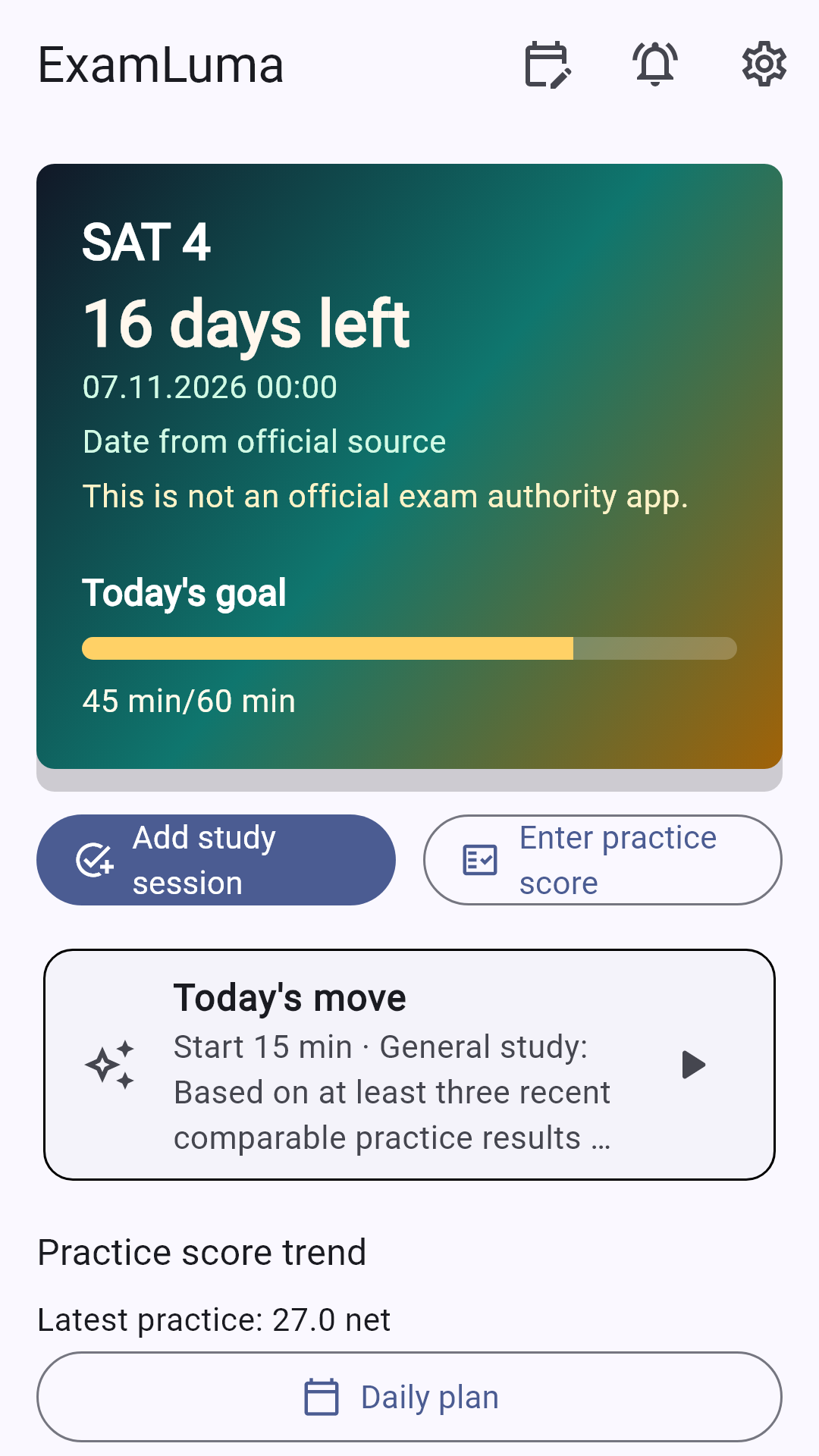
Select GMAT as your exam in ExamLuma and set a daily study-time goal. Start a focus session when you begin the planned task and save the completed block to your study log. At the end of the week, use your weekly statistics to compare the routine you planned with the work you finished. Adjust the next week’s workload and keep a clear task ready for your next session.
How ExamLuma helps
Keep track of your study plan in ExamLuma. ↗
Set a daily study goal and follow your progress. ↗
Record completed study sessions. ↗
Frequently asked questions
Which sections are in the current GMAT?
GMAC's mba.com lists Quantitative Reasoning, Verbal Reasoning and Data Insights. Plan your practice around those sections and use current materials for each.
What should I practise for Verbal Reasoning?
The official content guide identifies Reading Comprehension and Critical Reasoning. Practise locating support for an inference and explaining how a claim depends on its assumptions.
How should I approach Data Insights?
The official guide describes tasks involving information from sources such as text, tables and graphics. In practice, identify what the question asks before deciding which information matters.
How does ExamLuma help with GMAT preparation?
Select GMAT as your exam, set a daily study-time goal, time focus sessions and save completed study blocks. Use weekly statistics to adjust the workload around your commitments.
Sources
- GMAT Exam Structure · Graduate Management Admission Council
- GMAT Exam Content · Graduate Management Admission Council