AP Exam Scores: The Scale and College Credit Decisions
Each AP Exam reports achievement in a specific course. College Board converts exam performance into a grade using assessment rules for that subject. The grade offers guidance about potential college credit and placement; individual colleges decide how to recognise it. Read the official score meaning alongside the course's component weighting before drawing conclusions from practice marks.

Last updated:
What an AP score represents
An AP Exam result is attached to a particular course, such as AP Biology, AP U.S. History or AP Calculus. The subject matters because the skills being assessed and the tasks used to assess them are different. The College Board scoring guide explains that AP results use a 1–5 scale, which expresses the student’s level of qualification for potential college credit or placement.
The reported AP score is a final grade for that course, rather than a raw percentage of questions answered correctly. A student who writes a persuasive history response and a student who solves a calculus problem demonstrate different kinds of knowledge; each is assessed within the framework of the relevant AP subject. The AP score scale table provides the official interpretation of grades 1, 2, 3, 4 and 5.
How the composite score is created
College Board’s explanation of AP scoring says that most exams combine multiple-choice and free-response marks in a weighted composite. Other AP subjects include different assessment components, such as performance work. Examiners mark free-response work against the applicable criteria and the composite is converted to the final AP scale. The conversion takes subject-specific standards into account.
This means a raw practice mark needs context. A multiple-choice result in one course represents part of the examination outcome, especially when essays, document-based responses, practical work or another assessed task contributes to the final grade. When reading the results of practice papers, look up the course’s component weights and feedback criteria before deciding what to revise.
Interpreting college credit and placement
The official AP score information says many U.S. colleges grant credit or advanced placement for grades of 3 and above. However, a student’s actual credit, course exemption or placement outcome depends on the receiving institution’s policy. A college may recognise particular AP subjects, require a higher grade for a particular major or apply different rules to degree requirements.
Before you use an AP result to plan a timetable at college, check the institution’s published credit policy for the specific AP course. Also distinguish a score that supports advanced standing from a requirement for admission: those are separate decisions. A strong grade helps you understand your subject preparation, but the way it translates into university study is decided elsewhere.
Use the subject result to organise revision
If you are taking several AP subjects, avoid adding their reported grades into a made-up universal AP total. Instead, identify which course calls for more practice on free-response reasoning, which needs faster recall of key concepts and which would benefit from better time management. The AP Exams study guide can help you keep those courses organised with different priorities.
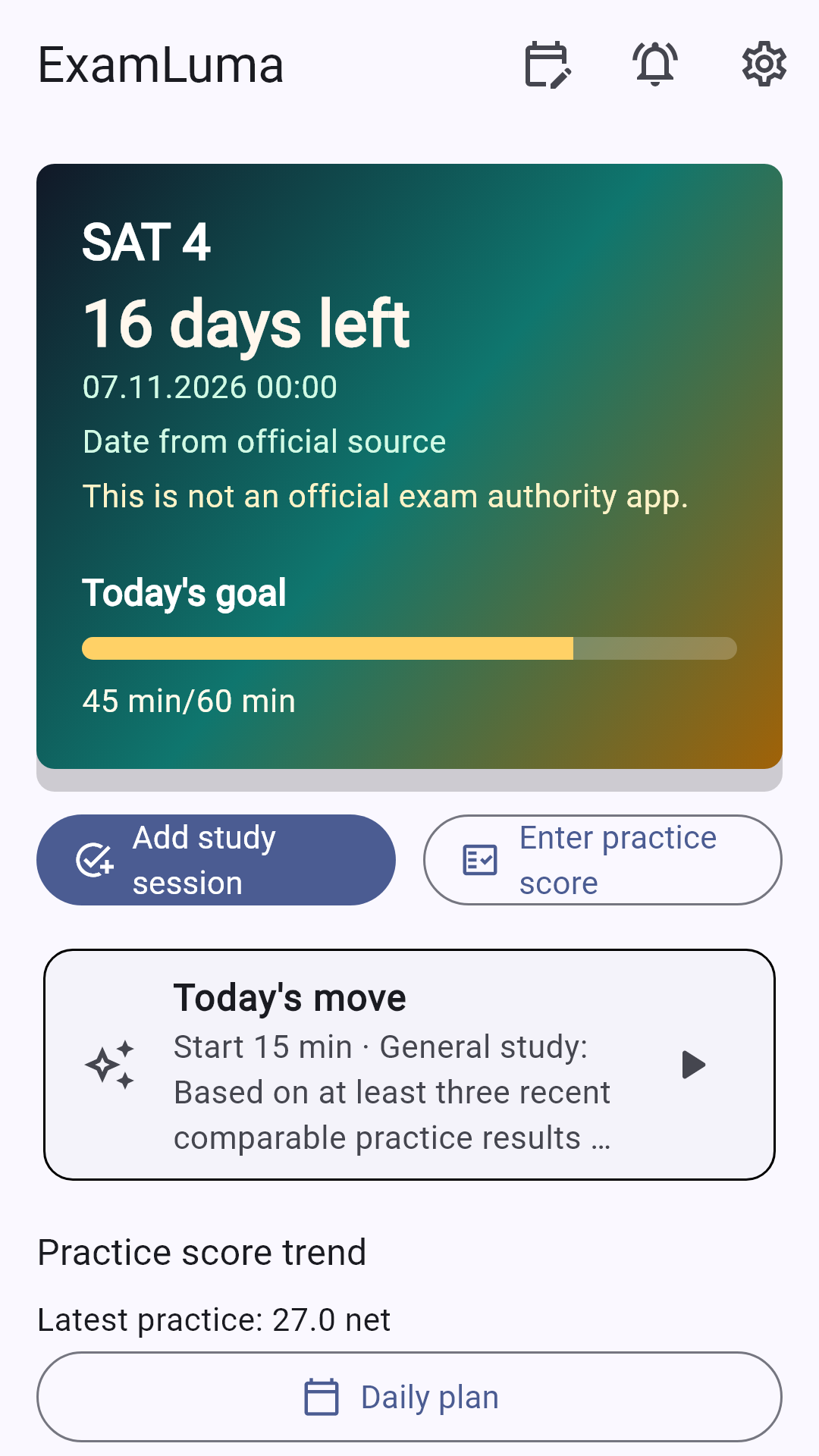
ExamLuma lets you select AP Exams as your target and follow a countdown, daily study-time goal and focus timer. Enter correct, wrong and blank counts from your own practice tests to follow your overall trend, and review your weekly study statistics when allocating time across subjects.
How ExamLuma helps
Keep track of your study plan in ExamLuma. ↗
Set a daily study goal and follow your progress. ↗
Record completed study sessions. ↗
Frequently asked questions
Do all AP Exams use exactly the same grading formula?
AP subjects can have different assessment components and scoring weights. Use the official information for the specific course before comparing practice marks.
Does an AP score guarantee college credit?
Colleges set their own policies about which subjects and scores earn credit or advanced placement. Check the policy for the institution and degree you are considering.
What should I compare when reviewing AP results across courses?
Compare each subject's reported grade with the course-specific expectations and its assessment components rather than adding different AP scores together.
Sources
- About AP Scores · College Board
- AP Score Scale Table · College Board