GED Scores: Passing, College Ready and Subject Results
GED results are reported separately for each subject, so the score in every area matters for completing the credential. The official scale sets the high school equivalency passing point and describes College Ready levels. Those categories have distinct meanings, particularly for college placement or credit. Read them alongside the policies of your jurisdiction and receiving institution.

Last updated:
Read each GED subject separately
The GED tests assess Mathematical Reasoning, Reasoning Through Language Arts, Social Studies and Science as separate subjects. Your score report shows your performance in each, so a strong result in science has a different role from a result in mathematics. Treat the subject scores as a checklist for your credential and as a guide to deciding which skills to improve next.
According to the GED Testing Service’s current score scale, each subject is graded from 100 to 200 and the passing threshold is 145 on every one of the four subject tests. The passing rule is applied subject by subject. A high mark on a completed subject leaves the remaining subject requirements in place. Use your report to see which tests have been completed at the passing level and which need another attempt.
Understand the College Ready categories
The official GED scale identifies GED College Ready in the United States as 165–174 and GED College Ready + Credit as 175–200 on an individual subject test. These categories sit above the high school equivalency passing requirement and are intended to signal readiness for further study. They refer to scores in the subject concerned rather than a single average across all the GED tests.
The separate GED score explanation describes College Ready as a basis for possible placement advantages and the higher category as a basis for possible college credit. Those possibilities depend on the college’s own rules. If you want to use your GED result for further education, look up the receiving institution’s credit and placement policy before building your plans around a specific benefit.
Use your result in its proper jurisdiction
GED requirements and recognition can involve your state or jurisdiction as well as the institution receiving your credential. Check the official rules for where you are testing, especially if your goal is employment, a training programme or college entry outside the place where you earned the result. Separate the question of passing GED from the question of how another organisation recognises it.
For preparation, work subject by subject instead of treating all practice as a single blended score. If Mathematical Reasoning is the subject that needs attention, distinguish errors involving graphs from errors involving algebraic relationships. For Reasoning Through Language Arts, decide whether missed questions stemmed from reading arguments, editing sentences or organising an extended response. The GED study guide can help you turn that diagnosis into a manageable routine.
Keep practice records separate from official scores
When you complete a practice paper, note the types of questions missed and what made them difficult. Compare practice performance within the same subject, and use the official GED scale only when interpreting a formally reported result.
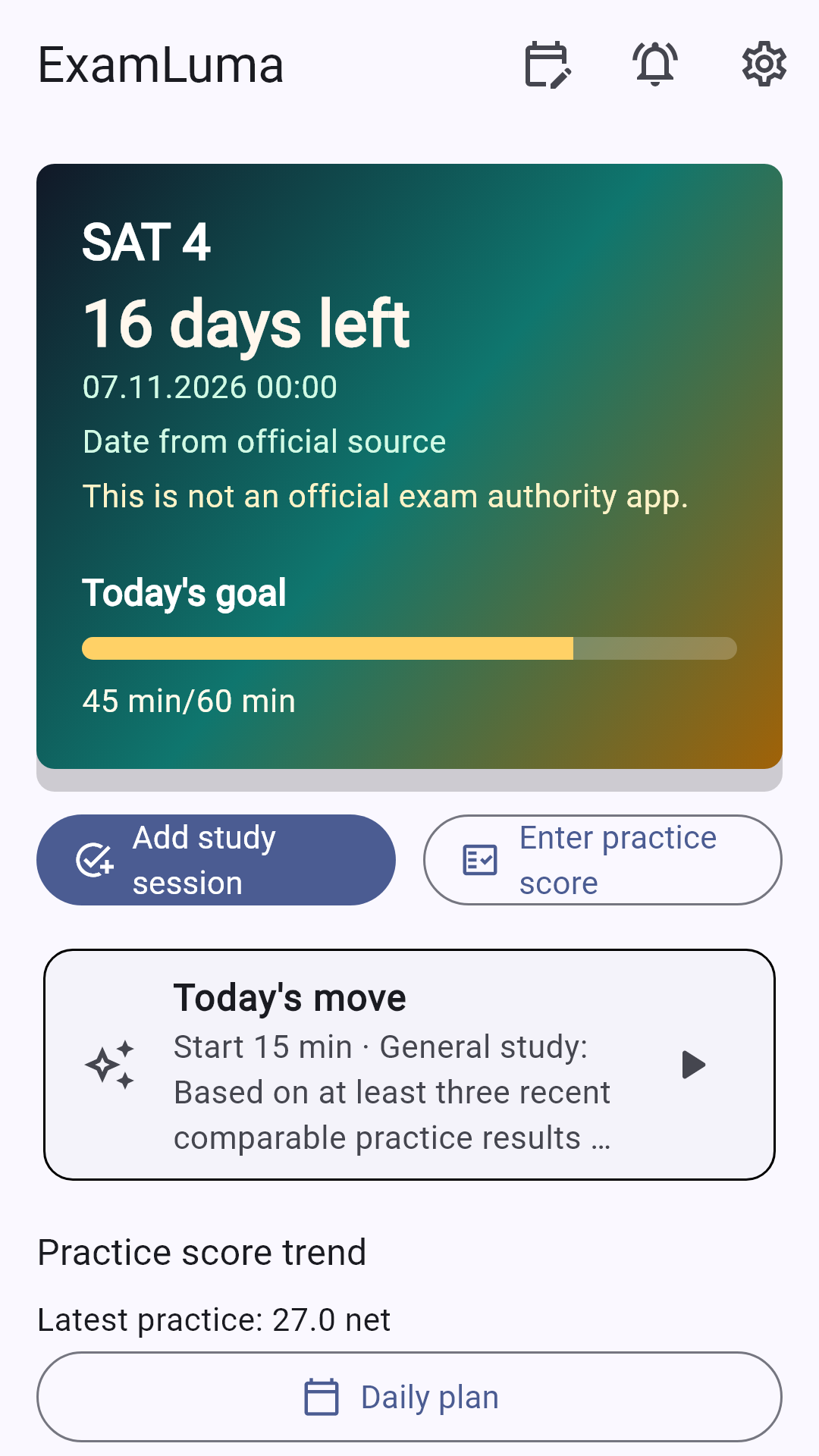
In ExamLuma, select the GED as your target, follow the exam countdown and set a daily study-time goal. Run the focus timer for specific practice blocks, enter correct, wrong and blank practice counts yourself, and review the overall trend and weekly study statistics as you work towards your next subject result.
How ExamLuma helps
Keep track of your study plan in ExamLuma. ↗
Set a daily study goal and follow your progress. ↗
Record completed study sessions. ↗
Frequently asked questions
Can a strong GED score in one subject offset a low score in another?
The GED uses a separate passing requirement for each subject. Review each result and complete the subjects where you still need to meet the passing level.
What is the difference between passing and College Ready?
Passing satisfies the subject's high school equivalency score requirement, while College Ready indicates a higher level associated with college preparation.
Does College Ready plus Credit automatically award college credits?
Credit recognition and exemptions depend on an institution's policy and relevant jurisdictional rules. Ask the receiving college how it evaluates GED scores.
Sources
- GED Score Scale and Content Descriptions · GED Testing Service
- Understanding Your GED Scores · GED Testing Service