CELPIP Levels, CLB Equivalencies and Results
The CELPIP General report describes reading, writing, listening and speaking performance on a level scale. A report can also display an average performance level, while immigration programmes assess their own requirements by language ability. Read component levels and Canadian Language Benchmark equivalencies separately to avoid overlooking a weaker required skill.

Last updated:
The CELPIP General report is most useful when you read each language ability on its own line. The CELPIP exam overview explains the assessment format. For results, begin with listening, reading, writing and speaking, then connect each official level to the purpose for which you need to submit it.
Read the skill levels independently
The Canadian CELPIP scoring guidance describes proficiency levels up to Level 12. They provide an interpretation of what a candidate can understand or produce in different contexts. A speaking result can represent a different performance profile from a reading result, so record them in distinct fields.
Use the relevant descriptors to make practice decisions. In speaking, notice whether the response directly addresses the situation. In writing, consider clarity, tone and the development of supporting details. Reading and listening call for their own comprehension strategies, and their results deserve separate notes.
Understand the reported average
The CELPIP score guidance says that the result can include an overall level labelled Average, calculated as the mean of 4 component levels and rounded to the nearest whole number. This is an additional summary of the test profile.
For an immigration application, keep the four original levels with that summary. A rounded average can conceal a lower result in a particular ability, while the receiving programme may specify a minimum requirement for that ability. Reading the full report prevents an applicant from treating the summary as the sole piece of relevant information.
Use IRCC’s benchmark conversion
The Canadian immigration department’s table maps CELPIP General levels 4–10 to corresponding Canadian Language Benchmark CLB 4–10 values for reading, writing, listening and speaking. The programme’s current rules determine which CLB level applies to an applicant.
Record the skill, CELPIP result, corresponding CLB and the application requirement in separate columns. A programme can ask for a minimum in every area, so check each one in turn. Use the current IRCC page for the application route and keep the test version visible on your record.
Convert the skill report into your next task
A speaking result that needs improvement may point to response structure, relevance or pace. For listening, consider tracking changes in the speaker’s position; for reading, look at the support for an inference; for writing, examine how the paragraphs serve the task. Practise the first unreliable decision on fresh material.
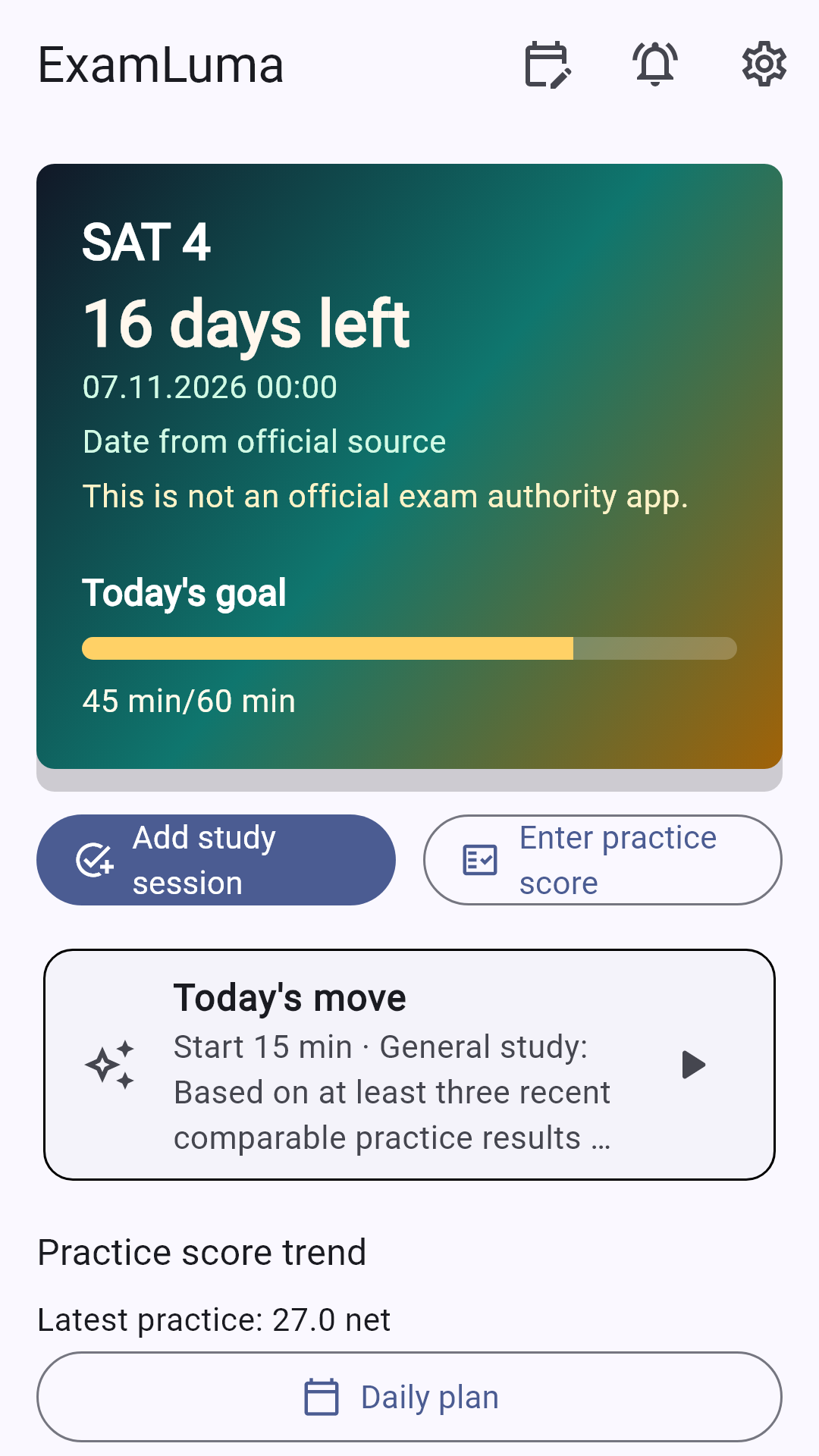
In ExamLuma, select CELPIP as your target and use the countdown, daily study-time goal and focus timer. Enter your practice correct, wrong and blank counts yourself and review the overall trend and weekly study statistics while planning your next task.
How ExamLuma helps
Keep track of your study plan in ExamLuma. ↗
Set a daily study goal and follow your progress. ↗
Record completed study sessions. ↗
Frequently asked questions
What does a CELPIP level represent?
It describes English language performance for a particular tested skill.
What is the role of the score-report average?
The report provides an overall summary level, while many Canadian immigration requirements compare component abilities separately.
Where do I check the CLB needed for my application?
Use Immigration, Refugees and Citizenship Canada's current tables for your specific immigration pathway.
Sources
- CELPIP Scoring Levels · CELPIP, Canada
- Official CELPIP Score Guidance · CELPIP, Canada
- IRCC English language benchmark conversion · Immigration, Refugees and Citizenship Canada