Gaokao scores: total, rank and admission lines
Gaokao results must be read within the province and admission category that issued them. The total mark, subject profile, rank position and provincial control line answer different questions. Zhejiang offers a useful concrete example, but its grading and tie-breaking rules apply specifically to the Zhejiang admission system.

Last updated:
Your Gaokao result has meaning only alongside the province and admissions category that issued it. A Gaokao examination overview explains preparation and subjects; reading an admissions result requires a different set of questions. Start by noting your province, examination route and subject choices. Then separate the total mark from the provincial rank and the university requirements you intend to meet.
Why provincial totals use different scales
The Chinese Ministry of Education’s admissions guidance directs applicants to provincial plans, score-position tables and university admissions regulations. Provincial systems use their own grade conversions, which makes the local rulebook essential for interpreting a total. A subject that receives an assigned grade in one region may be handled differently in another; even the set of subjects feeding the total can differ.
For a concrete illustration, Zhejiang’s published 2026 admission rules assign 150 points each to Chinese, Mathematics and Foreign Language and 100 points each to three selected subjects, producing a 750-point total. Selected-subject grades use assigned scores starting at 40 and advancing in one-point steps. Those figures apply specifically to Zhejiang’s admission system.
Read a rank alongside a mark
A total indicates your performance on the scale used for your cohort. Rank describes where that performance falls among the other applicants in the relevant provincial group. Zhejiang’s official score-distribution table lists score bands and cumulative candidate counts. The table helps you interpret relative position while keeping historical marks in their original cohort.
When reviewing university options, keep the university, programme, province and admission route in one record. Look up the programme’s eligibility requirements and planned intake through official university information. A provincial control line organises admission categories; each course’s eventual outcome is a separate decision. Subject prerequisites and university rules can still matter.
What to do with a mixed subject profile
A student with strong language marks but weaker selected-subject results may need different preparation from someone with the same total and the opposite profile. Read each subject result before building a study plan. Check whether a weakness comes from answering the question, interpreting the material or handling time pressure. Historical tables are useful for context only when province, category and cohort are identified.
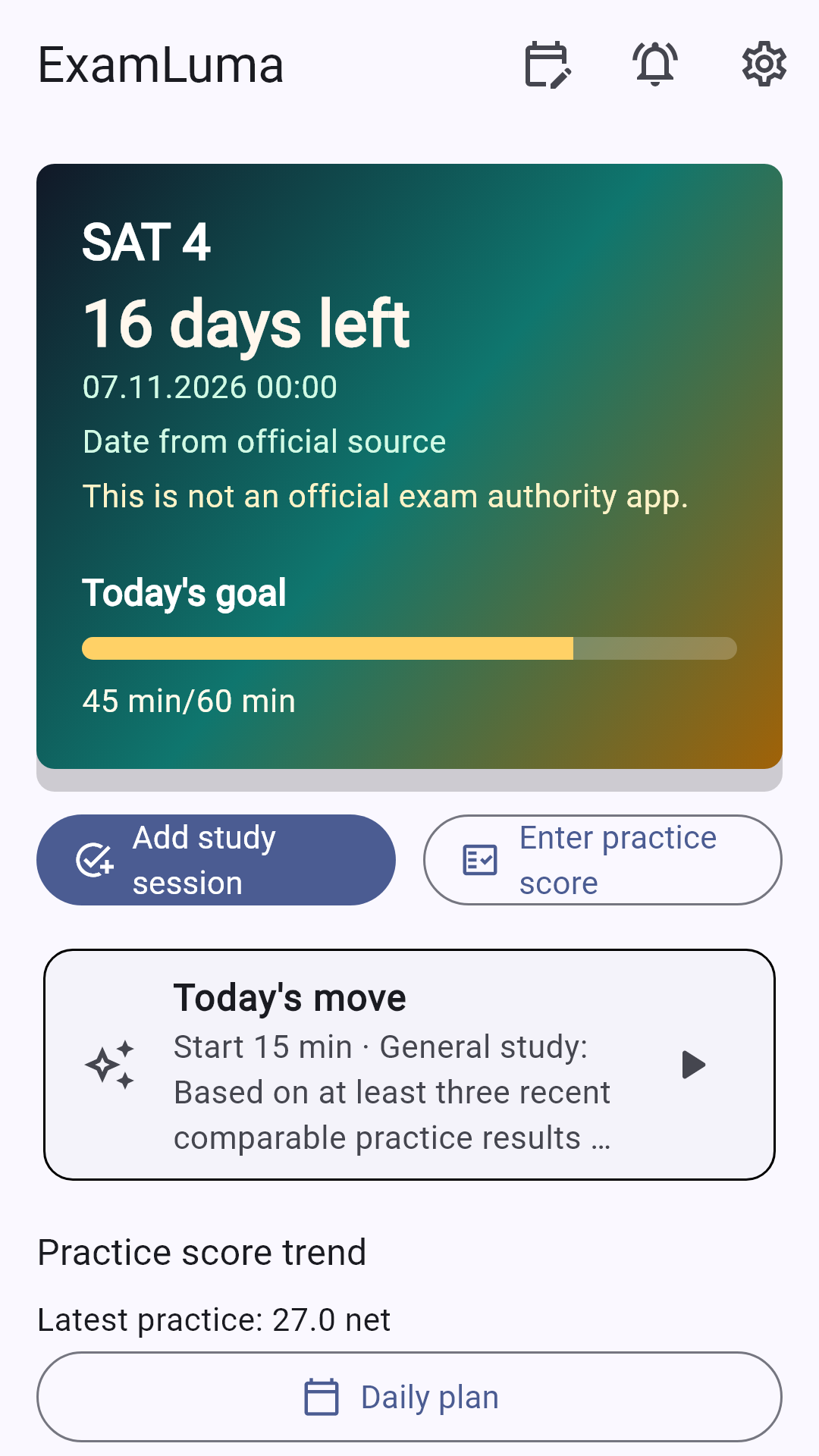
ExamLuma lets you select Gaokao as your goal exam, use a countdown and daily study-time goal, and run a focus timer. Enter practice outcomes yourself to follow the overall trend and weekly study statistics while keeping official ranks and admission rules in your application notes.
How ExamLuma helps
Keep track of your study plan in ExamLuma. ↗
Set a daily study goal and follow your progress. ↗
Record completed study sessions. ↗
Frequently asked questions
Can I compare Gaokao totals from two provinces directly?
The comparison requires matching subject selection, grade conversion and admissions category within the same provincial cohort.
What does a one-mark-one-rank table tell me?
It lists candidates in score bands and cumulative counts, helping you locate your position among comparable applicants.
Does crossing a provincial control line guarantee admission?
Admission also depends on each university's published requirements, places and application procedures.
Sources
- Ministry of Education Gaokao application guidance · Ministry of Education, China
- Zhejiang 2026 Gaokao admission and grading rules · Zhejiang Education Examinations Authority
- Zhejiang official score distribution table · Zhejiang Education Examinations Authority