Italian Maturità Scores: Credits, Exams and Honours
The Italian Esame di Stato, usually called maturità, uses both school credit accumulated before the examination and results from the final written and oral assessments. Your final certificate reports the regulatory total, potentially including an additional award or honours. Read the components separately before interpreting the final grade.

Last updated:
Which marks belong on the final certificate?
Italy’s maturità marks completion of the final stage of upper-secondary schooling. It combines the credito scolastico, earned through the final school years, with assessments at the state examination. The final mark is consequently a regulated combination of several components. Before studying the total, identify the school credit, the results assigned by the examining commission and any special award printed on your official record. The maturità exam guide covers the examination route.
Credits, papers and oral examination
Under the consolidated state rules, school credit can contribute up to 40 points. In the ordinary format, the 2 written tests contribute up to 20 points each, with the oral examination contributing up to 20 points. The examination is passed with at least 60 points out of 100. This makes school credit a meaningful part of the result rather than a separate certificate detail.
Certain school pathways use a different assessment arrangement. The official regulation provides for separate distributions where the number of written papers differs. Check your own track before adding the components. A conversion published for another type of school could misrepresent the contribution of the tests you actually took.
Supplementary points and lode
The state rules allow the examining commission to add up to 3 points when the initial total reaches at least 90. This is a permitted commission decision under its rules, so confirm whether it was applied on the official result. The lode distinction is a separate form of recognition that may accompany 100 points under conditions including the absence of supplementary points.
The distinction between the base result, a commission addition and a formal honours award matters for international applications. A school may ask for the actual final grade alongside the type of qualification. Keep the original terms on your certificate rather than estimating an equivalent foreign grade on your own.
Reviewing a result for future study
Separate long-term subject gaps from weaknesses that appeared in a timed written paper or oral discussion. For practice, record whether a problem concerned finding a legal or scientific definition, presenting a coherent argument or responding under questioning. These patterns guide revision more reliably than repeatedly converting partial marks into predicted certificate totals.
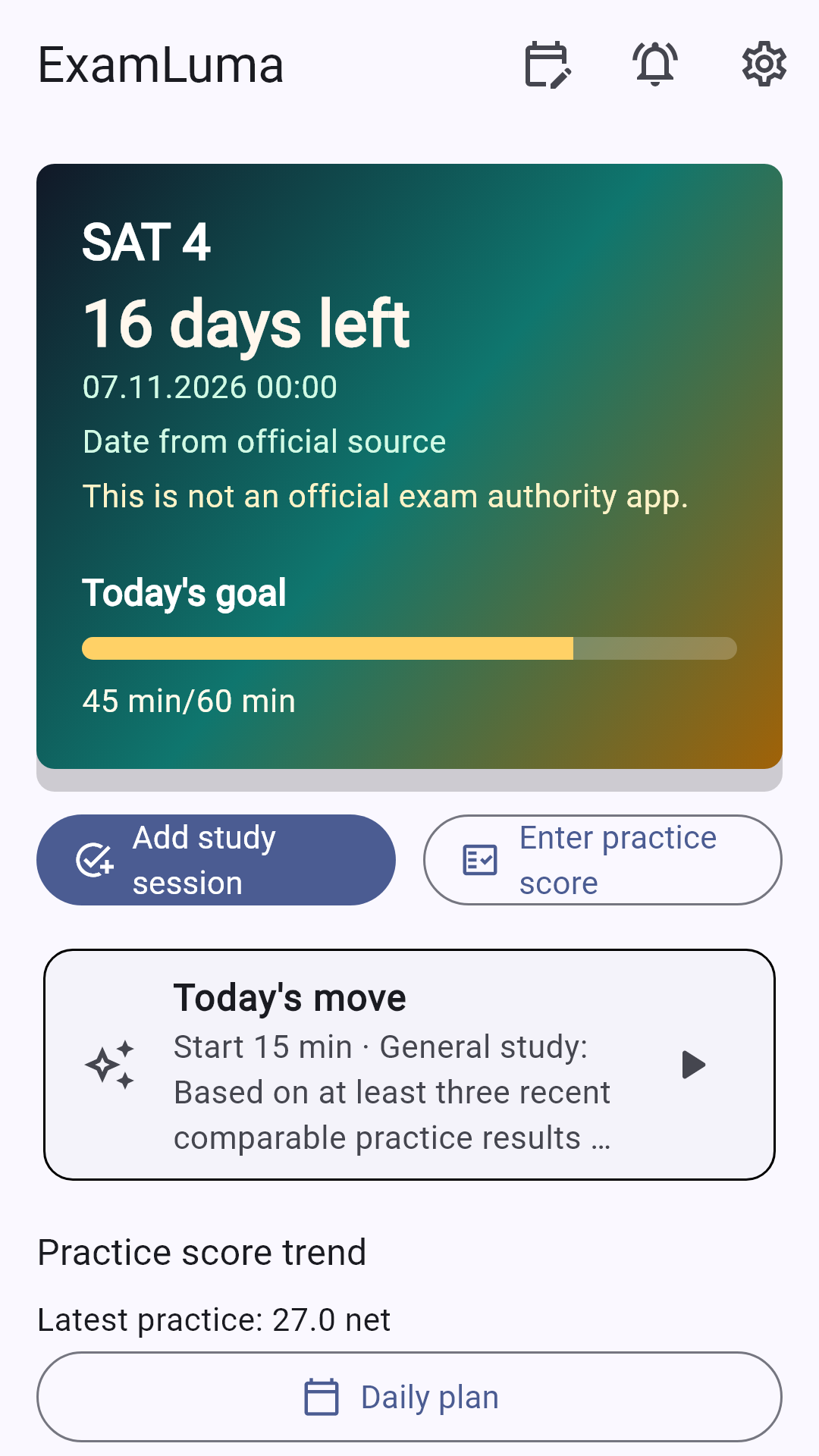
In ExamLuma, choose maturità as the exam goal, follow the countdown and set a daily study-time target. Use focus sessions for weaker areas and enter correct, wrong and blank practice counts to monitor overall trends and weekly study statistics.
How ExamLuma helps
Keep track of your study plan in ExamLuma. ↗
Set a daily study goal and follow your progress. ↗
Record completed study sessions. ↗
Frequently asked questions
Does the oral examination replace the written tests?
The ordinary total combines school credit and the prescribed written and oral assessments.
Is an additional award automatic for high scores?
Any permitted supplementary points depend on the examining commission's decision under the applicable conditions.
What does lode signify?
Lode is a separate honours recognition awarded under stricter rules than those for an ordinary pass.
Sources
- Consolidated Italian state-examination regulation · Gazzetta Ufficiale della Repubblica Italiana