Dutch State Language Exam: Scaled Scores and Results
The Dutch state examination for learners of Dutch as an additional language assesses reading, listening, writing and speaking separately. Each component has an official scaled result, and the same numeric passing standard applies while possible score ranges can differ by test. Compare results within the right programme and skill.

Last updated:
A separate result for every language skill
The Dutch State Examination of Dutch as a Second Language is used to demonstrate proficiency for education, work and other requirements. The score report treats reading, listening, speaking and writing as separate skills. Rather than reducing everything to a single headline number, identify which component has already met the prescribed standard and which still needs attention. The Dutch language exam overview describes the examination programmes and their intended purposes.
Understanding the passing scaled score
According to the official assessment explanation, each component requires a scaled score of 500 or higher for a passing result. The scaled number is the outcome of the examining organisation’s scoring process. Reading and listening use computer marking of answers, whereas speaking and writing involve trained human assessors applying assessment criteria. This makes a practice tally of correct answers a different kind of information from an issued scaled score.
For written and spoken work, the same official assessment account describes assessment by 2 trained evaluators. If a productive-language result surprises you, review the criteria for the task type rather than applying a multiple-choice conversion rule. Look for patterns in clarity, accuracy, task completion and organisation of the answer.
Why the score range varies
The candidate questions page explains that the minimum and maximum possible scaled scores can vary across components and examination dates. General ranges published for guidance describe typical scoring conditions, while your actual official result comes from the assessment taken. The passing standard stays central when interpreting your report, even where the top and bottom of the displayed scale change.
Keep the examination programme and the skill name with your result. DUO explains that Programme I corresponds to CEFR B1 and generally serves vocational education, while Programme II corresponds to CEFR B2 and generally serves higher education. A pass in the reading section describes that skill and programme; an organisation asking for a complete diploma may require the full set of component passes. Confirm the precise requirements with the receiving school or employer.
Making a skill-specific study plan
Target the weakest component with the kind of practice it assesses. Use timed reading passages for comprehension difficulties, authentic audio for listening, structured prompts for writing and spoken rehearsal for oral fluency. Keep written feedback alongside your official results; it can explain why a response reached a particular level.
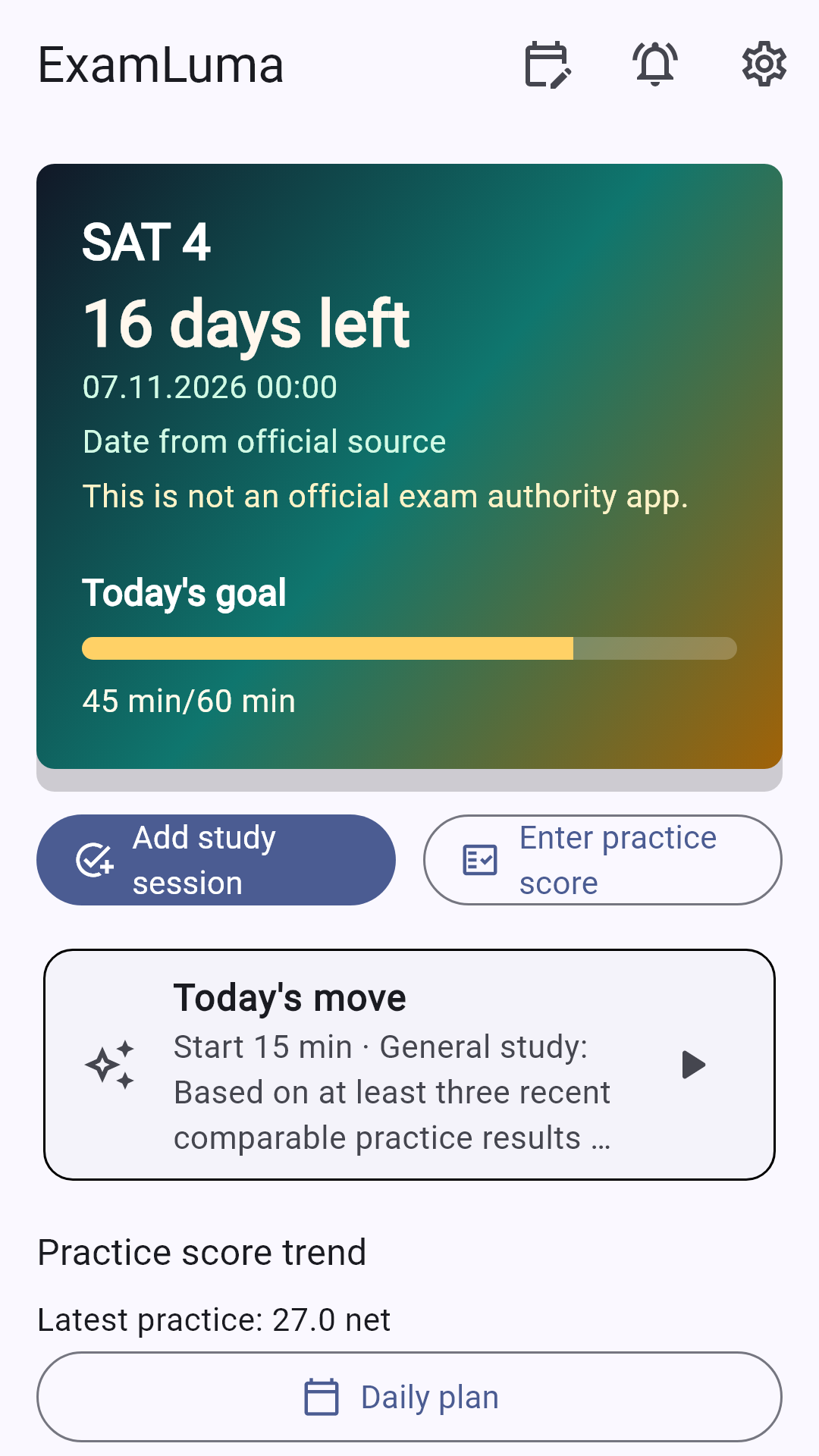
ExamLuma can organise preparation around the Dutch state language exam with a countdown, daily study-time target and focus sessions. Enter practice counts of correct, incorrect and unanswered questions for an overall trend and review your weekly study statistics.
How ExamLuma helps
Keep track of your study plan in ExamLuma. ↗
Set a daily study goal and follow your progress. ↗
Record completed study sessions. ↗
Frequently asked questions
Can I pass individual language skills separately?
Each of the required language components receives its own result, which can be checked against the component passing standard.
Is the official score simply my count of correct answers?
The organisation uses scoring and assessment procedures that depend on the language skill.
Why should I check the programme?
The Dutch state exam has different programmes for distinct education and language needs.
Sources
- Staatsexamens Nederlands als tweede taal: Assessment · Staatsexamens Nt2
- State Dutch exam: Questions from candidates · Staatsexamens Nt2
- DUO: State Examination Dutch as a Second Language programmes · Dienst Uitvoering Onderwijs