Praxis Scaled Scores and State Passing Rules
Praxis teaching certification score reports include an overall test score and diagnostic information for content areas. Many assessments use a scaled score to make different forms comparable, while individual states and licensing agencies set their own qualifying standards. Read the specific test code and the receiving jurisdiction's requirement before deciding how to use the result.

Last updated:
A Praxis score only becomes meaningful after you identify the exact test and the state that will review it. The Praxis exam overview describes preparation across teaching subject areas. Your score report adds a scaled result and diagnostic content categories that need to be interpreted in the context of the correct licensing requirement.
Read the specific test’s scaled score
The official Praxis technical manual describes a commonly used 100–200 score scale for many selected-response Praxis tests. Raw results are converted to scaled scores after accounting for differences in examination forms. Related assessments can follow a different scale, making the exact test name and code essential.
The ETS score-reading page shows that the report identifies the possible score range for the specific test. Record that official range beside the score instead of assuming that every Praxis examination shares the same numerical limits.
Find the qualifying rule for the licensing agency
The ETS Praxis guidance explains that states or licensing agencies set qualifying scores. A reported result may satisfy the policy in one jurisdiction and require a different comparison in another. A state’s published requirement is the authority for certification eligibility.
Keep the destination jurisdiction, test code and any corresponding qualifying score in your application tracker. When an examination has been updated, check which test version is being accepted. ETS also notes that updated tests may use a different reporting scale, so comparing identical-looking numbers across versions can be misleading.
Use content categories as diagnostic information
According to ETS’s score report description, content categories can show raw points earned and raw points available. The report also provides the middle 50% of scores for that test as a reference. The content category totals support practice planning; the scaled overall result is used for the qualifying-score comparison.
When selecting a study priority, examine the difference between your earned and available content points. A large gap suggests a category worth investigating, although the type of error still matters. Separate a knowledge gap from misunderstanding a scenario or making a weak professional judgment.
Plan a retake by the actual difficulty
Use an unfamiliar practice scenario and explain why the selected response best meets the test’s objective. In a constructed response, identify the criterion that the answer addressed least effectively. Test a new approach before another full-length attempt, and check the official state policy before changing your application timeline.
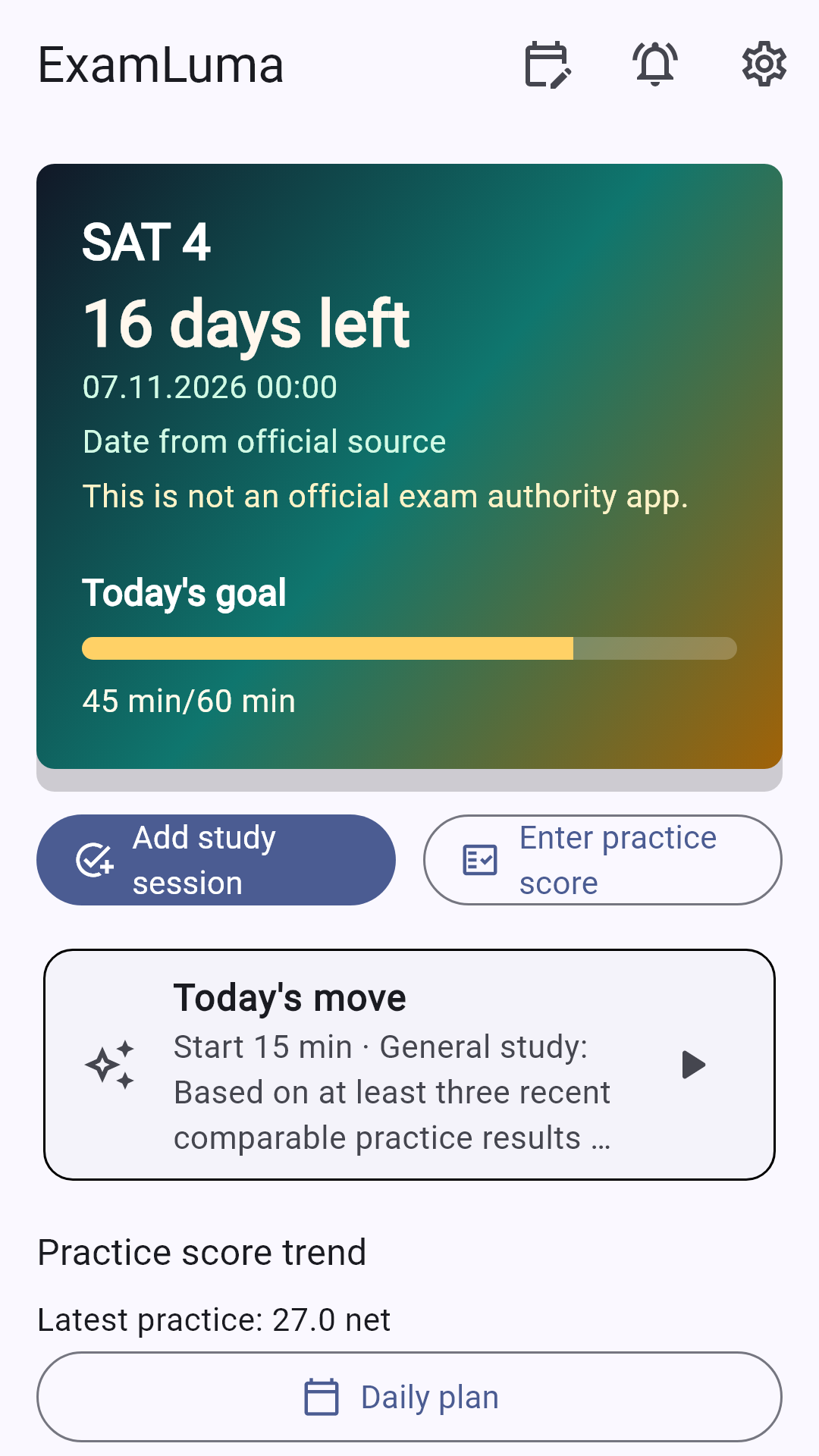
In ExamLuma, choose Praxis as your target, follow the countdown, set a daily study-time goal and use a focus timer for one content area. Enter correct, wrong and blank practice counts yourself to follow overall trends and weekly study statistics.
How ExamLuma helps
Keep track of your study plan in ExamLuma. ↗
Set a daily study goal and follow your progress. ↗
Record completed study sessions. ↗
Frequently asked questions
Who sets the Praxis passing score?
The relevant state or licensing agency sets the qualifying result for its requirements.
Why are raw and scaled points different?
ETS uses scaling to account for differences between test forms.
How do I use content category results?
Compare raw points earned with raw points available in each category to identify a useful preparation priority.
Sources
- Understanding Praxis scores · Educational Testing Service, United States
- Praxis Technical Manual · Educational Testing Service, United States