Thanaweya Amma Scores: New and Old Egyptian Systems
Egypt's Thanaweya Amma is a secondary school leaving examination whose marks need to be read in the correct examination system. The current and older systems have different subject arrangements, so their totals should stay separate. Start with the official Ministry of Education result, then check the appropriate system and subject list before comparing admissions information.

Last updated:
Thanaweya Amma is Egypt’s general secondary school leaving certificate examination. The number on the result sheet needs context: the examination system, the stream of study, and the subjects counted toward the aggregate. Begin with the Thanaweya Amma exam overview to identify the curriculum route. Then read your official result as a record of that route, rather than comparing it with another student’s total before checking which system each person followed.
Start with the examination system on the result
The Egyptian Ministry of Education’s official results portal is the appropriate starting point for a certificate result. Check the candidate information and subject entries on your own record. The ministry’s examination framework has changed, while some candidates are still assessed under older arrangements. Write down whether your document relates to the newer or older system and keep that distinction beside every score comparison.
The Ministry’s official 2026 top-results listing records 320 marks for a leading science-stream candidate and displays separate science, mathematics and literary categories. This figure is an individual candidate’s reported score. For the maximum attainable total and counted subjects, consult the examination instructions applicable to the student’s own system. Keep candidate marks distinct from each system’s score scale.
Why the older subject arrangement needs its own reading
The Ministry’s earlier examination instructions describe an older arrangement in which Arabic and both the first and second foreign languages were among general subjects counted toward the aggregate, alongside stream-specific subjects. The booklet also separates counted subjects from subjects assessed for passing but excluded from the aggregate. These are historical instructions, useful for recognising why older and newer result documents can differ in their subject composition.
For an older-system result, keep the marks and aggregate exactly as reported by the Ministry for that route. Check the instructions attached to your own examination session when identifying which subjects counted. A conversion based only on dividing an old total by the newer system’s maximum could conceal the difference in subject lists and marking rules. If you compare two certificates for an application, retain each system’s original reported figures and the authority’s instructions rather than inventing a common scoring formula.
Read subjects and university requirements separately
The official total summarises a particular set of examined subjects. A subject mark is more useful when diagnosing whether you need additional practice in comprehension, mathematical reasoning or a science topic. A stream label helps you keep science, mathematics and literary requirements in their correct context. The Ministry’s result publication provides the authoritative record; an informal practice mark serves a different purpose.
University admission can involve its own eligibility and coordination rules. Begin with the institution and intended programme, then check the admissions authority’s current instructions for that programme and your examination system. Preserve the certificate, its subject breakdown and its system label when making a preference list. Historical cutoffs describe earlier admissions outcomes, whereas your actual eligibility is established through the current process.
Use the reported results to guide study
Choose the subject where your practice mistakes reveal the clearest opportunity to improve. For a reading task, identify the sentence that supports an answer; for mathematics, explain the setup before calculating; for a science topic, check whether the error came from recalling a fact or applying it to a new problem. Compare your practice attempts using the same subject and assessment method.
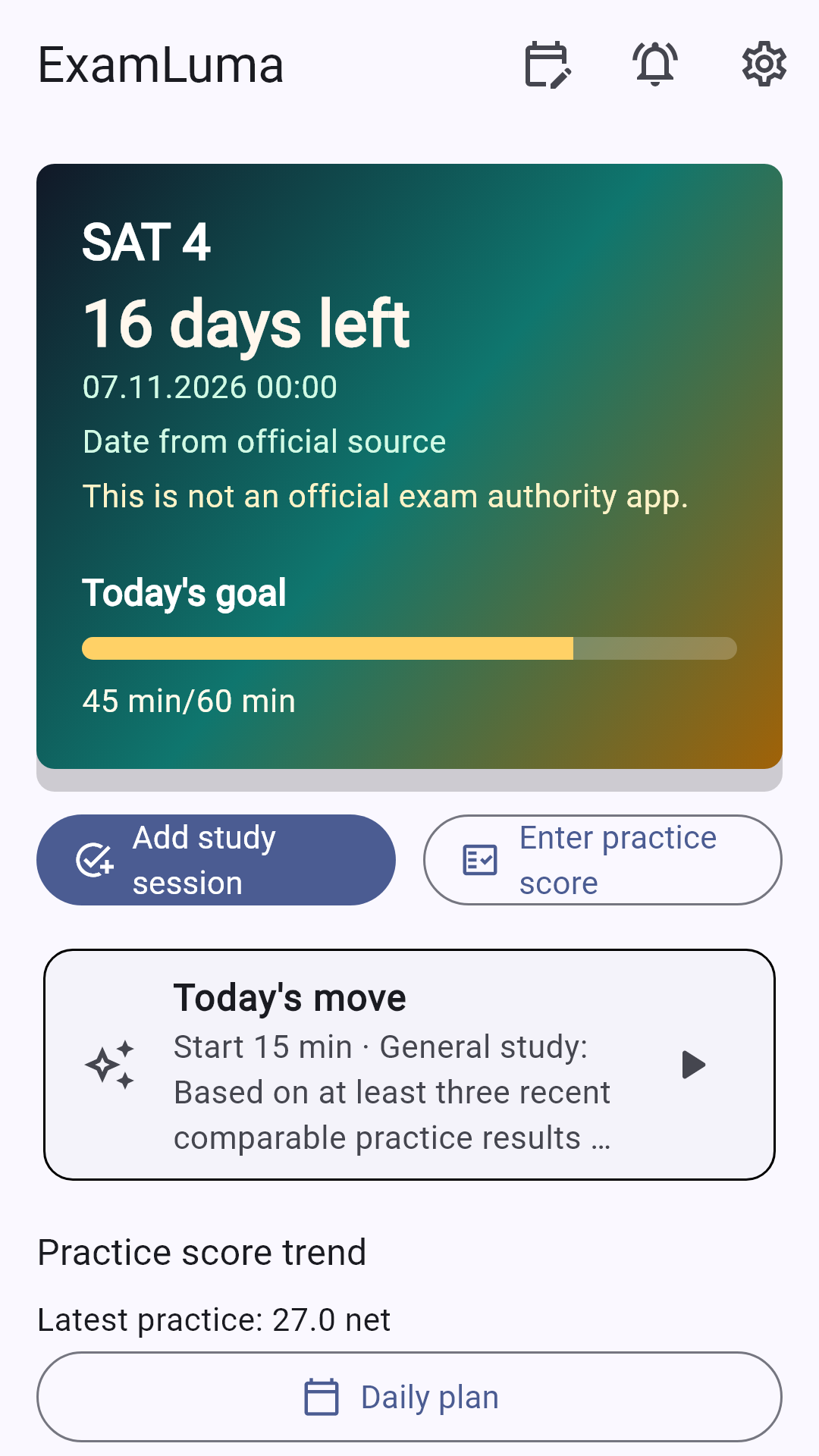
In ExamLuma, select Thanaweya Amma as the study target, follow the countdown, set a daily study-time goal and use the focus timer for focused revision. Enter your own practice answer counts and review your overall trend and weekly study statistics while keeping official certificate marks in their original record.
How ExamLuma helps
Keep track of your study plan in ExamLuma. ↗
Set a daily study goal and follow your progress. ↗
Record completed study sessions. ↗
Frequently asked questions
Can I compare a new-system total directly with an old-system total?
Read each total with its own system's maximum and set of counted subjects; the totals belong to different scales.
Where should I check my result?
Use the Egyptian Ministry of Education's official results portal and verify the examination system and subject marks on your own record.
Does a certificate total guarantee admission to a particular university?
University placement follows the current admissions process and programme eligibility conditions, which are separate from the school examination result.
Sources
- Egyptian Ministry of Education official Thanaweya Amma top results · Egyptian Ministry of Education and Technical Education
- Egyptian Ministry of Education official general secondary result portal · Egyptian Ministry of Education and Technical Education
- Egyptian Ministry of Education older-system candidate instructions · Egyptian Ministry of Education and Technical Education