TOEFL iBT Scores: New Scale and Report Guide
Current TOEFL iBT reports show an overall score and separate Reading, Listening, Speaking and Writing results on the updated band scale. Start with your test date, distinguish the current score from the temporary legacy comparison, then match both the overall and section requirements published by each institution.

Last updated:
Your TOEFL iBT report is easiest to read when you begin with the date printed beside the test. A report from the updated test and a report from the earlier format can contain familiar-looking numbers that play different roles. Use the official result as the source for applications, and use the TOEFL iBT exam guide when you want to turn the score profile into a practice plan.
Identify the scale from the test date
For tests taken on or after January 2026, ETS reports Reading, Listening, Speaking, Writing and the overall result on a 1–6 scale in 0.5-point increments. ETS explains the effective date, the four section scores and the current scale on its score guide. Read the overall score first for a broad view, then keep the four section results beside it because an institution may care about both.
Read the band labels as scaled performance indicators for each language skill. Compare Reading with Reading across attempts and use the band description to understand the level represented. Apply the same method to Listening, Speaking and Writing.
Understand the overall-score calculation
The current overall score is the average of the four section scores, rounded to the nearest 0.5. In ETS’s official examples, 5.125 becomes 5, while 5.25 becomes 5.5. ETS gives these rounding examples in its official score-report FAQ. Keep the unrounded average only as a check; use the rounded overall score shown on the official report when completing an application.
A similar overall result can hide different skill profiles. One candidate may be balanced across all sections, while another may combine stronger receptive skills with a weaker productive section. Read the section pattern before deciding what to practise next or whether you meet a programme’s separate minimums.
Read the transition comparison correctly
During the two-year transition after the score-scale update, ETS also places a comparable overall 0–120 score on the updated report. It represents the midpoint of the corresponding legacy total-score range. ETS describes this temporary comparison alongside the current band result. Treat it as an overall comparison while the four current section bands remain the section profile.
Tests from the earlier score-reporting period retain the former report: each section is on 0–30, and the four sections produce a 0–120 total. ETS distinguishes the former score structure from the updated scale in its institutional guidance. When comparing attempts, label each result by scale instead of placing the two totals in one undifferentiated column.
Match the report to an institution’s requirement
ETS states that institutions set their own TOEFL iBT requirements and may ask for both an overall result and particular section results. The score-scale update directs institutions to define their own requirements. Open the current page for the exact programme, intake and study level. Record the accepted test date, the scale used in the wording, the overall requirement and every section condition.
If a page still presents only the former scale, look for an institution-issued conversion or updated policy. Keep the current band score and the comparable legacy total in separate fields so that you can reproduce what the institution actually asks for. Avoid inventing a section conversion when ETS supplies only a comparable overall value.
Turn the section profile into the next practice task
Use the weakest section as a starting clue, then inspect the work behind it. A lower Reading result may reflect support selection, vocabulary in context or pacing; a lower Speaking result may come from incomplete development, clarity or delivery. Choose one observable issue, test it with new material and carry the finding into the next full practice test.
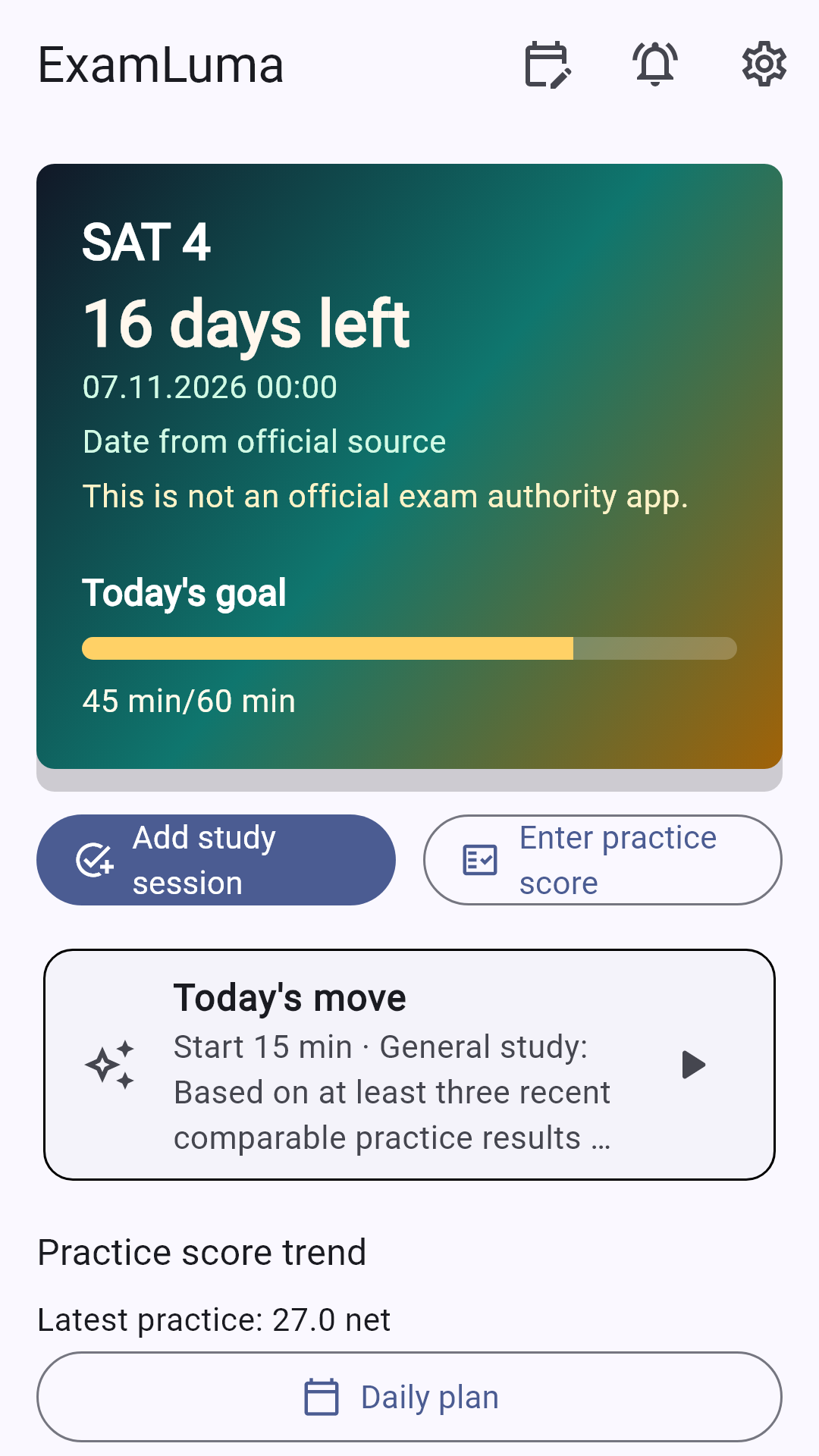
ExamLuma lets you select TOEFL as your target, view the countdown, set a daily study-time goal and use the focus timer. After a practice test, enter the result yourself to follow the overall trend and weekly statistics, then schedule the section task that your review identified.
How ExamLuma helps
Keep track of your study plan in ExamLuma. ↗
Set a daily study goal and follow your progress. ↗
Record completed study sessions. ↗
Frequently asked questions
Which TOEFL iBT score scale applies to my result?
Use the test date. Results from the updated test use the current band scale, while earlier results remain on the former section-and-total scale.
How is the current overall score calculated?
ETS averages the four section scores and rounds the result to the nearest half band according to its official rule.
Why does a current report also show a comparable legacy score?
ETS provides the comparable overall value during the transition so institutions and applicants can relate the updated scale to familiar requirements.
Should I check only an institution's overall requirement?
Check both the overall requirement and any separate Reading, Listening, Speaking or Writing minimums, using the institution's current admissions page.
Sources