Türkiye
How to Study for DGS: Numerical, Verbal & Study Plan
Exam dates from official calendars, together in one place.
Moving from an associate degree to an undergraduate program through the Vertical Transfer Examination starts with a balanced routine across numerical and verbal reasoning. By pairing targeted topic study with structured error review after every practice test, you build both speed and accuracy. Use this study plan and ExamLuma to organize your preparation.
Last updated:
Upcoming sessions
DGS
Your countdown starts when the official date is announced
Date from official source ↗Checked:
Past sessions (1)
DGS
Date from official source ↗Checked:
Subjects
- General study
- Practice tests
Transitioning from your associate degree to a bachelor’s program becomes much clearer when you organize your daily study around the core reasoning skills tested in Turkey’s Vertical Transfer Examination (DGS). According to ÖSYM’s 2026 DGS guide, the exam evaluates your numerical and verbal abilities to support progression from relevant associate-degree programs toward undergraduate study, while official announcements and guide documents are published on the ÖSYM DGS examination page.
Understand the DGS structure and score components
Your preparation covers two primary skill areas: numerical ability and verbal ability. On the numerical side, you work with basic number operations, ratios and proportions, word problems, table and graph interpretation, and multi-step numerical logic. On the verbal side, you build fluency in word and sentence meaning, paragraph comprehension, and verbal logic puzzles. Prioritize the section that carries greater weight for your target undergraduate degree while keeping a steady baseline in the other section so both contribute to your result.
Turn practice tests and scoring rules into steady gains
Per ÖSYM’s 2026 DGS guide, raw scores deduct 1/4 of wrong answers before the results are standardized and combined with your associate-degree achievement component under the official score rules. Because accuracy directly protects your net score, reviewing why an error happened matters just as much as solving new sets. After each timed session, categorize every missed question by its specific topic and apply a structured practice test review method before scheduling your next drill on that subject.
Sample 12-week plan
Organize your weekly schedule into focused blocks so you cover foundational concepts first and transition smoothly into timed problem-solving.
Weeks 1–4
Build your foundation in core arithmetic and reading comprehension during weeks 1–4. Spend 60 minutes a day on basic numbers, ratios and proportions, and fundamental equations, paired with 45 minutes on word meaning, sentence meaning, and short paragraph drills. Finish each week by solving 40 untimed review questions to solidify the rules you studied.
Weeks 5–8
Shift your focus to high-yield problem types and analytical reading across weeks 5–8. Dedicate 75 minutes daily to rate, percentage, and mixture word problems alongside table and graph interpretation sets. Pair this with 45 minutes of long paragraph comprehension and introductory verbal logic sets, plus 1 timed section check every weekend.
Weeks 9–12
During weeks 9–12, emphasize multi-step reasoning and pacing under timed conditions. Run 60-minute daily drills combining numerical logic puzzles with word problems and table interpretation, followed by 45 minutes of verbal logic and dense paragraph sets. Complete 2 full practice tests each week and spend 40 minutes logging and re-solving every missed question.
The final 4–8 weeks
In the final 4–8 weeks, center your routine on full-length practice exams and targeted topic repair. Take 3 timed practice tests per week, then use 60-minute follow-up blocks to revisit ratios, word problems, numerical logic, or paragraph comprehension based on your error log. Keep a daily 30-minute warm-up of paragraph and numerical logic drills to keep your reading and calculation speed sharp.
Track your preparation with ExamLuma
Select DGS in ExamLuma to keep your study routine organized in one place. Set your daily study goals, start focus sessions that automatically add completed time to your subject study log, and record your practice test results after every practice exam. Your weekly statistics show how your study hours and net scores develop across your study sessions and practice exams so you always know which subject needs your next focus block.
How ExamLuma helps
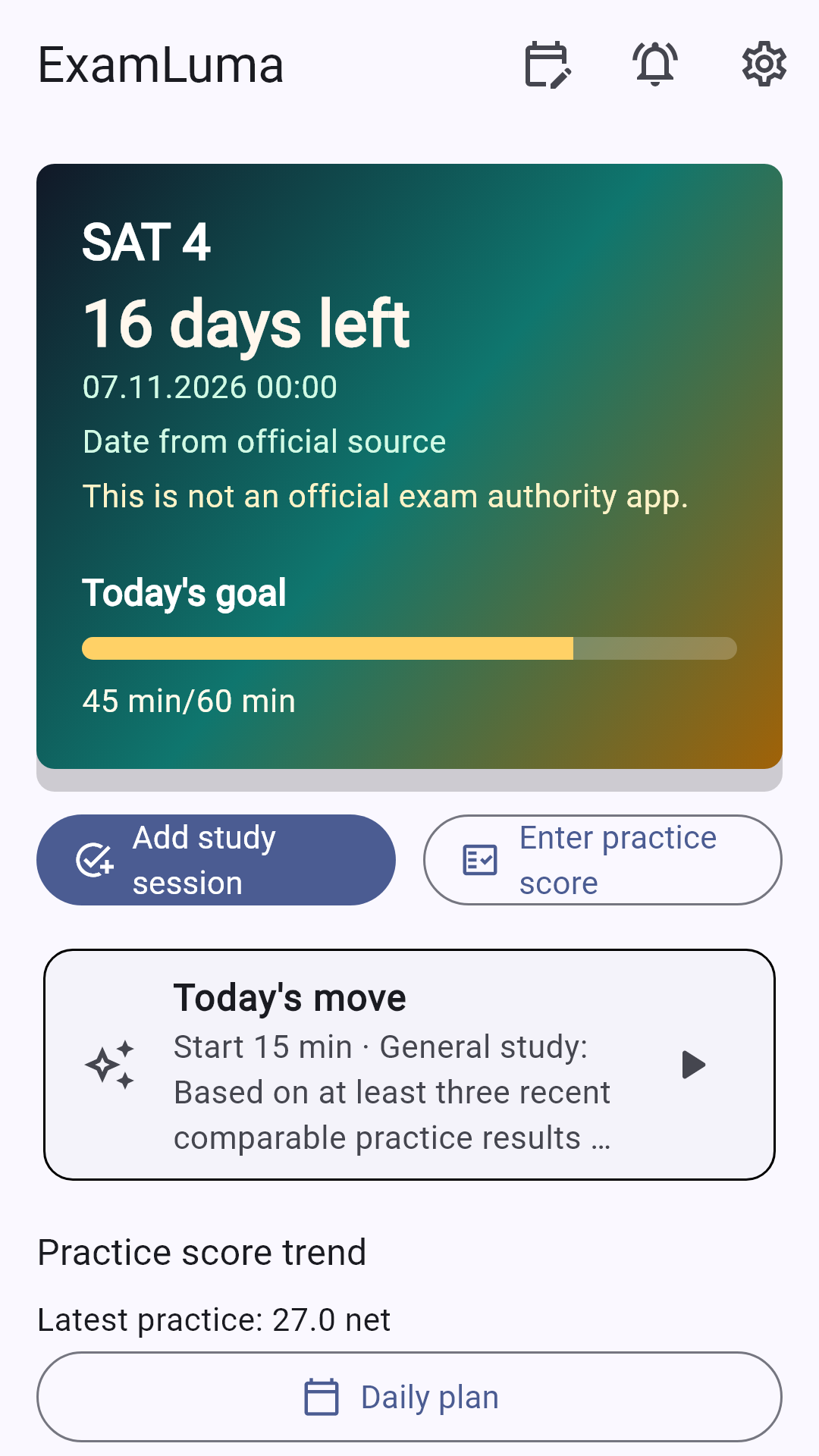
Keep track of your study plan in ExamLuma. ↗
Set a daily study goal and follow your progress. ↗
Record completed study sessions. ↗
Frequently asked questions
What subjects should I prioritize when studying for DGS?
Focus primarily on the ability section that aligns with your associate degree and target undergraduate program, while maintaining regular practice in the other section. Within numerical study, word problems and numerical logic reward daily practice, while paragraph comprehension and verbal logic anchor your verbal preparation.
How does my associate degree performance fit into the DGS score?
According to ÖSYM's DGS guide, your standardized numerical and verbal test scores are combined with your associate-degree achievement score to form your placement score. Keeping your test accuracy high across both sections maximizes the value of your academic background.
How should I review my DGS practice tests?
After finishing a practice test, group your incorrect answers by topic such as ratios, word problems, paragraph comprehension, or logic puzzles. Re-solve those specific questions untimed first to master the underlying method, then schedule a focused drill on the same topic later in the week.
How can I track my DGS study routine in ExamLuma?
You can set daily study goals, run focus sessions that log time directly to your study subjects, and enter your practice test results after each session. Your weekly statistics display your study consistency and score trends in one clear view.
Sources
- DGS Guide and Application Information · ÖSYM · 2026
- ÖSYM DGS Examination Group Index · ÖSYM