United States
How to Study for the SAT: Section Study Plan
Exam dates from official calendars, together in one place.
Strong SAT preparation balances Reading and Writing with Math across a structured study plan. Because the digital exam adapts between modules, consistent accuracy on foundational questions unlocks higher-scoring opportunities. This guide gives you a structured multi-week plan, targeted section routines, and a clear method for turning missed practice test questions into higher section scores with ExamLuma.
Last updated:
Upcoming sessions
SAT 4
Date from official source ↗Checked:
SAT 5
Date from official source ↗Checked:
SAT 6
Date from official source ↗Checked:
SAT 7
Date from official source ↗Checked:
SAT 8
Date from official source ↗Checked:
Past sessions (3)
SAT 1
Date from official source ↗Checked:
SAT 2
Date from official source ↗Checked:
SAT 3
Date from official source ↗Checked:
Subjects
- General study
- Practice tests
Raising your SAT score starts with matching your daily study blocks to the exact skills tested in each section and reviewing every practice mistake by topic. Whether you are a high school junior preparing during the school year or a senior using summer blocks before application season, a repeatable routine keeps your coursework and test prep moving together.
Understand the digital SAT structure and score scale
According to College Board’s official guide on how the SAT is structured, the SAT is digital and adaptive, built around 2 sections: Reading and Writing, and Math. Each section contains 2 separately timed modules, and your performance in the first module determines the difficulty level of the second module. College Board’s explanation of what SAT scores mean reports the SAT total score on a 400–1600 scale combining both section scores. During Bluebook practice, time each module, flag any question that is taking too long so you can return to it within the same module, and review that exact topic right after the test.
Sample 12-week plan
This 12-week schedule breaks preparation into 3 clear phases so you build accuracy first and pacing second. Adjust the workload below to fit your school schedule and current section scores.
Weeks 1–4
In this opening phase, schedule 4 weekly study sessions of 45 minutes each. Dedicate 2 sessions to Reading and Writing mechanics, focusing on sentence boundaries and subject-verb agreement across short passages. Use the other 2 sessions for Math foundations, working through linear equations and ratios step by step. Finish week 4 with 1 timed single-section check to establish your baseline accuracy.
Weeks 5–8
During the middle phase, move up to 5 weekly study sessions of 50 minutes each. In Reading and Writing, practice logical transitions and reading inference questions where you connect claims to specific details in the passage. In Math, focus on quadratics and data analysis, including percentages, scatterplots, and two-way tables. Complete 1 full-length digital practice test every 2 weeks on a weekend morning.
Weeks 9–12
In the third phase, keep 5 weekly sessions of 60 minutes each while shifting to mixed-topic sets that mirror adaptive modules. Add geometry and trigonometry problems to your Math drills, and combine grammar rules with reading inference in timed Reading and Writing sets. Take 1 full practice test at the end of every week and spend the next day re-solving every missed item from scratch.
The final 4–8 weeks
When you enter the final 4–8 weeks before your test window, shift your routine toward targeted error recovery and steady test-day rhythm. Use your weekly study schedule to alternate a 45-minute grammar or inference block with a 45-minute algebra or geometry block across 5 weekdays, then reserve 1 weekend session for mixed practice. After every weekend practice test, run a structured practice test review to sort errors by topic—such as transitions, sentence boundaries, quadratics, or geometry—and rework 3 similar questions for each missed topic during your weekday sessions.
Track your SAT prep with ExamLuma
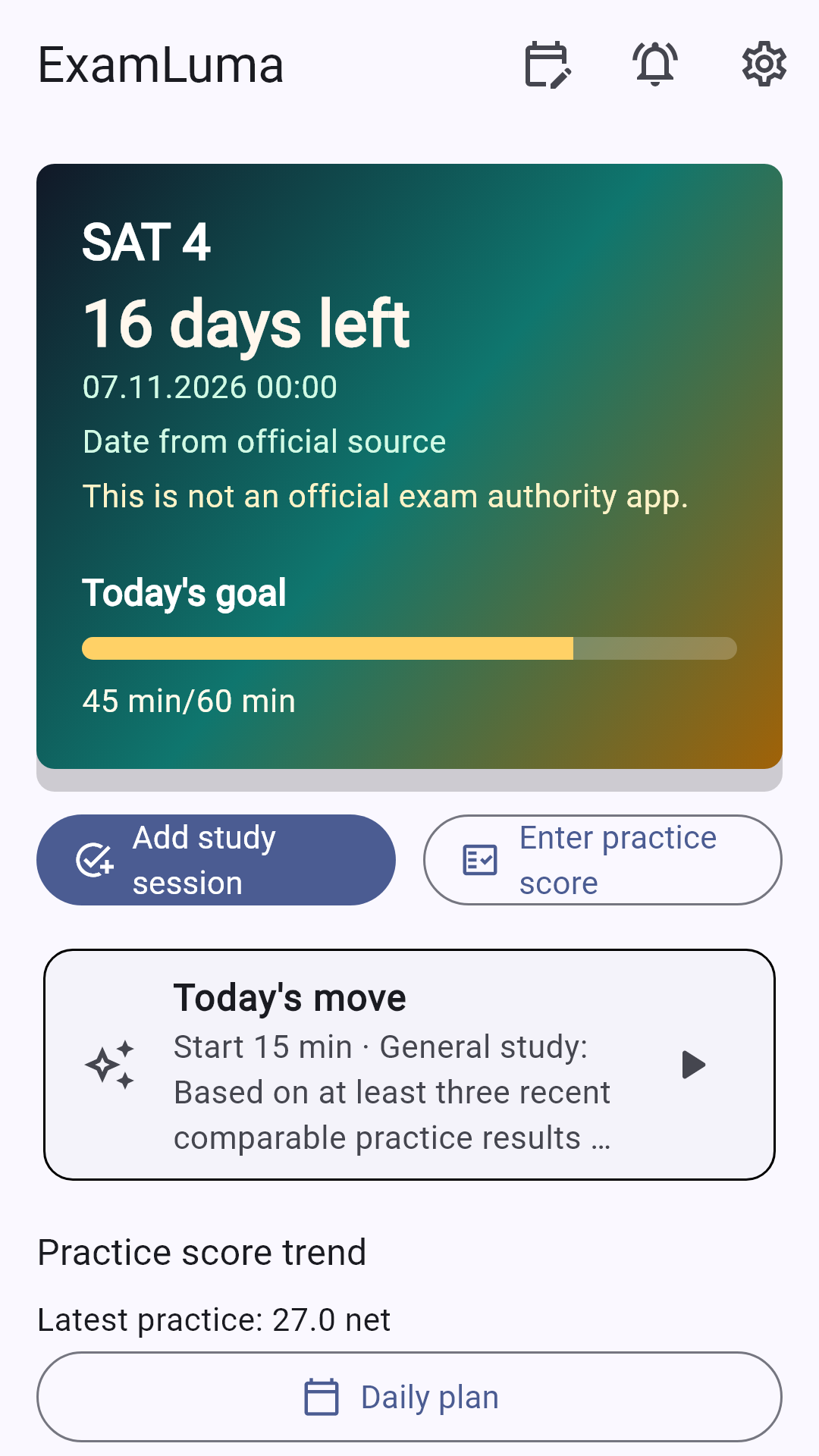
ExamLuma turns your SAT study plan into daily action right on your phone. Set daily goals for your study time, start focus sessions while you drill Reading and Writing or Math, and save every block to your study log. After each full practice test, enter your results into the practice-result log and check your weekly statistics to watch your consistency and section progress grow week by week.
How ExamLuma helps
Keep track of your study plan in ExamLuma. ↗
Set a daily study goal and follow your progress. ↗
Record completed study sessions. ↗
Frequently asked questions
When should a junior or senior start an SAT study plan?
Starting a structured multi-week plan well ahead of your target test window gives you enough room to master core grammar rules, build algebra fluency, and complete full-length practice tests alongside regular high school coursework.
How should you split study time between Reading and Writing and Math?
Use your baseline section scores to guide your weekly balance. Give extra weekday blocks to the section with the largest room for growth while keeping regular weekly sessions on your stronger section to protect your momentum.
What is the best way to keep an SAT error log while studying?
Record the exact topic and root cause for every missed practice question, such as sentence boundaries, transitions, linear equations, or ratios, then rework similar questions on that topic before your next full practice test.
How does ExamLuma help with daily SAT preparation?
ExamLuma lets you set daily goals, run timed focus sessions, record study logs by subject, enter practice-result logs after each practice test, and view weekly statistics on your phone.
Sources
- How the SAT Is Structured · College Board
- What SAT Scores Mean · College Board