SAT Focus Blocks: Finish Tasks and Stay on Track
Sitting down to study with an open-ended task invites distraction. Pairing a single SAT skill with a defined work block and a brief reset keeps your attention on the problem in front of you. You finish a concrete task, check why answers worked, and log your progress cleanly.
Last updated:
Open your study session by naming the exact task you will complete before standing up for a break. Choose the exact question set before opening extra browser tabs or checking phone alerts. Pairing one concrete skill with a timed work block and a short reset turns vague desk time into finished practice.
Match each block to a single SAT skill
Effective focus blocks start with a narrow target drawn from your recent practice results. In College Board’s study plan guide, students are encouraged to organize study activities around available time and examine why previous questions were missed. Instead of mixing unrelated subjects in one sitting, dedicate the block to a single area from the Reading and Writing section overview—such as Standard English Conventions or Craft and Structure—or one domain from the Math section overview, like Algebra or Advanced Math. You can align these skill choices with the structure of the exam in our SAT study guide before setting your timer.
The IES study guide recommends alternating worked examples with independent problem-solving and asking explanatory questions as you learn. A focused block gives you the quiet window needed to study a worked solution, solve a fresh problem on your own, and write down why the method works.
Sample plan: SAT focus blocks and 7-day rotation
1. Run a 25-minute Reading and Writing block with a 5-minute break
Set a 25-minute timer for Standard English Conventions, focusing on punctuation boundaries between clauses. Spend the first 15 minutes answering 10 practice questions with explanations covered until the review step. Keep a scratch sheet next to your screen: for each item, write the main subject and verb of each clause before picking the punctuation mark. Use the final 10 minutes to compare your answers with the question set’s explanations, then take a 5-minute break away from your screen. For questions from a completed Bluebook practice test, College Board’s My Practice provides explanations for every answer choice.
2. Run a 35-minute Math block with a 10-minute reset
For Algebra and Advanced Math, set a 35-minute block targeting linear equations and nonlinear functions. Spend 20 minutes solving 8 problems by alternating 1 worked example with 1 independent problem. Write your algebraic setup on scratch paper first, then decide whether a calculator helps evaluate or graph the expression. The College Board calculator policy describes the embedded Bluebook Desmos calculator. Spend the remaining 15 minutes writing a 1-sentence note on any step where a sign error or function substitution slowed you down, followed by a 10-minute reset.
3. Follow a 7-day focus-block rotation
- Monday: 1 block of 25 minutes on Standard English Conventions (punctuation and sentence boundaries) + 5 minutes break; 1 block of 35 minutes on Algebra (linear equations in 1 variable) + 10 minutes break.
- Tuesday: 1 block of 30 minutes on Information and Ideas (central ideas and supporting details) + 5 minutes break; 1 block of 30 minutes on Advanced Math (quadratic functions) + 5 minutes break.
- Wednesday: 1 block of 25 minutes on Craft and Structure (words in context) + 5 minutes break; 1 block of 35 minutes on Problem-Solving and Data Analysis (ratios and percentages) + 10 minutes break.
- Thursday: 1 block of 30 minutes on Expression of Ideas (rhetorical synthesis and transitions) + 5 minutes break; 1 block of 35 minutes on Algebra (systems of 2 linear equations) + 10 minutes break.
- Friday: 1 block of 25 minutes on Standard English Conventions (verb tense and agreement) + 5 minutes break; 1 block of 35 minutes on Geometry and Trigonometry (right triangles and area) + 10 minutes break.
- Saturday: 2 blocks of 35 minutes reviewing missed Bluebook practice questions across Reading and Writing and Math, with a 10-minute break between blocks.
- Sunday: 1 block of 20 minutes organizing your scratch-paper error notes and choosing the first topic for Monday.
Track your focus sessions in ExamLuma
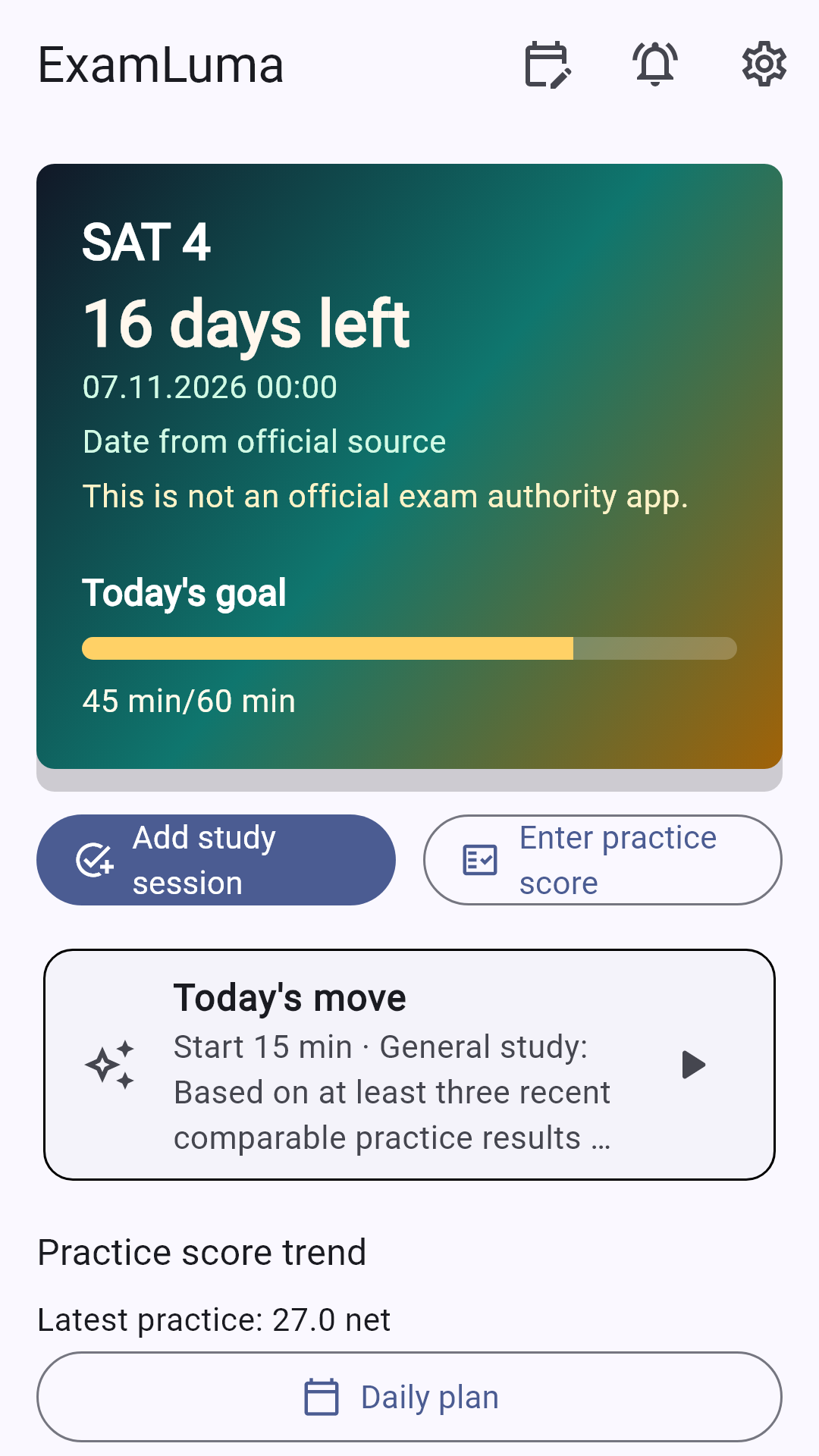
Put your daily study-time goal into ExamLuma and start a focus session whenever you sit down for a block. While you work through your scratch-paper setups and explanation checks, the timer runs cleanly; as soon as you finish, that completed time is recorded under your chosen SAT subject. You can also place your daily blocks into the weekly study planner to print a desk copy and review your weekly statistics in the app to keep your study habit steady.
How ExamLuma helps
Keep track of your study plan in ExamLuma. ↗
Set a daily study goal and follow your progress. ↗
Record completed study sessions. ↗
Frequently asked questions
What should I pick before starting a focus timer?
Choose one specific skill, such as punctuation boundaries in Standard English Conventions or linear equations in Algebra, and decide exactly what you will finish before the break.
How do I handle distractions during an active study block?
Keep a blank corner on your scratch paper to jot down stray errands or notifications, then return immediately to the current question until your break begins.
Should I use a calculator during every Math focus block?
Set up the equation on scratch paper first so you understand the structure, then decide whether the built-in Bluebook Desmos calculator speeds up the arithmetic.
How does ExamLuma track my focus sessions?
You start the focus timer for your chosen subject, and when you finish the block, ExamLuma adds that completed time directly to your subject study record.
Sources
- Organizing Instruction and Study to Improve Student Learning · Institute of Education Sciences · 2007
- Build Your SAT Suite Study Plan · College Board
- My Practice 101 · College Board
- The Reading and Writing Section · College Board
- The Math Section · College Board
- SAT Suite Calculator Policy · College Board