90-Day SAT Study Plan: Phases for Reading and Math
Give your SAT preparation a clear sequence: begin with equation setups and sentence boundaries, revisit functions and passage reasoning, then bring the topics together in mixed practice. Use your practice results and personal notes to choose each return task. This guide provides a filled phase plan and a study-time tracking routine in ExamLuma.
Last updated:
Organize your SAT preparation by skill phase
Building a phase-based roadmap lets you sequence SAT topics logically. According to the College Board study plan guide, effective preparation starts with considering your available time, using your practice results, and examining why you missed questions to choose activities suited to your schedule. If you prefer building a routine around open calendar days, organize your blocks with our weekly study plan guide.
To balance your study blocks, align them with official domains. The College Board Reading and Writing overview covers Information and Ideas, Craft and Structure, Expression of Ideas, and Standard English Conventions. The College Board Math overview covers Algebra, Advanced Math, Problem-Solving and Data Analysis, and Geometry and Trigonometry. As you map out your subject balance across the test, check our SAT exam overview to pair each section with your study log.
The IES study guide recommends spacing learning over time, alternating worked examples with independent solving, using retrieval quizzes, identifying skill gaps, and asking explanatory questions. After Bluebook practice, the College Board My Practice guide recommends reviewing results and reading explanations for all answer choices. During Math practice, write the model on scratch paper and decide whether a calculator would help. Keep a note of the setup you used so you can explain it again at the next session.
Sample plan: 90-day SAT phase roadmap
Weeks 1–4: Algebra and grammar foundations
Study 45 minutes on 5 days per week. Spend 25 minutes solving 12 Algebra problems on linear equations and systems, alternating 1 worked example with 1 independent problem. Spend 20 minutes completing 10 Standard English Conventions items on punctuation and verb agreement, noting the grammar rule for each mistake.
Weeks 5–8: Advanced Math and supporting details
Study 50 minutes on 5 days per week. Use 30 minutes to solve 12 Advanced Math and Problem-Solving and Data Analysis items on quadratics, exponents, and ratios, deciding when scratch work beats Desmos. Use 20 minutes for 10 Information and Ideas and Craft and Structure questions on supporting details and vocabulary.
Weeks 9–12: Mixed practice and explanation analysis
Study 60 minutes on 5 days per week. Complete a 35-minute mixed retrieval quiz from your study resources: 15 Reading and Writing items—including Expression of Ideas transitions—and 15 Math items including Geometry and Trigonometry. Spend 25 minutes checking the supplied solutions and updating your personal notes. When reviewing a separate Bluebook practice test, use My Practice for its answer explanations.
Days 85–90: Final 6-day review
Across days 85–90, run 30-minute daily sessions using your personal notes. On days 85–88, rework 8 missed Algebra and Advanced Math items plus 8 grammar and supporting-detail questions daily. On days 89–90, review your core formulas, grammar notes, and the next short practice task.
Track your daily goals and sessions in ExamLuma
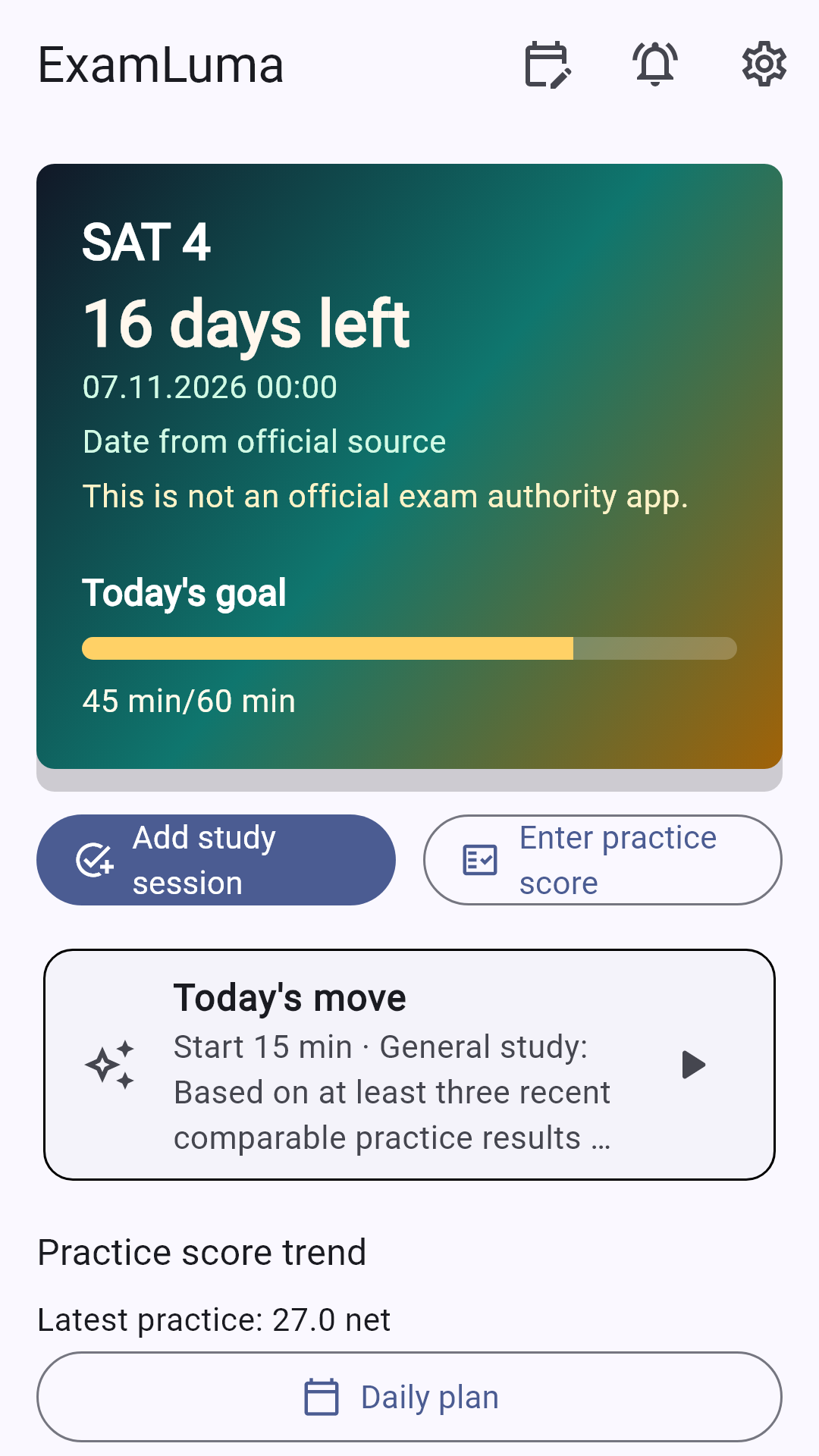
ExamLuma keeps your preparation organized from start to finish. Set your daily study-time goal, start a focus session for Reading and Writing or Math, and have your completed time recorded under that subject. After each practice test, log your score record and check your weekly statistics to watch your study consistency grow.
How ExamLuma helps
Keep track of your study plan in ExamLuma. ↗
Set a daily study goal and follow your progress. ↗
Record completed study sessions. ↗
Frequently asked questions
How should I use My Practice after a Bluebook practice test?
Open My Practice to check your results and read the explanations for every answer choice, then write down why the right answer works and what trap caught you in your personal study notes.
When should I use the built-in Desmos calculator during Math prep?
Set up your mathematical model on scratch paper before reaching for the calculator, and practice with the embedded Bluebook Desmos graphing or scientific tool whenever computation or graphing speeds up your solution.
How does a phase-based study roadmap differ from a weekly calendar template?
A phase roadmap sequences what you study—moving from foundational concepts to advanced problem solving and mixed explanation analysis—while a weekly calendar maps those tasks onto your open days.
Sources
- Build Your SAT Suite Study Plan · College Board
- My Practice 101 · College Board
- The Reading and Writing Section · College Board
- The Math Section · College Board
- SAT Suite Calculator Policy · College Board
- Organizing Instruction and Study to Improve Student Learning · Institute of Education Sciences · 2007