SAT Spaced Review: Study & Retrieval Plan
Space your SAT review across separate days and give each return session a clear task. Recall an equation setup or grammar rule, compare your answer with a worked solution, and note the next step to practice. This guide shows a filled topic rotation and a way to track completed study time in ExamLuma.
Last updated:
Revisiting key SAT skills across separated days gives you repeated opportunities to recall formulas and explain reading decisions. Instead of finishing a topic in one marathon block and moving on, you leave space between sessions and pull the method back from memory each time.
According to the IES study guide, spacing learning across separate sessions, alternating worked examples with independent problem solving, and using retrieval quizzes help you identify knowledge gaps and build deeper understanding through explanatory questions. In College Board’s study plan guide, you build your routine around your available schedule by reviewing practice results and examining why specific questions were missed. You can apply these methods directly across the official SAT Math section areas—Algebra, Advanced Math, Problem-Solving and Data Analysis, and Geometry and Trigonometry—as well as the SAT Reading and Writing section domains of Information and Ideas, Craft and Structure, Expression of Ideas, and Standard English Conventions.
Sample plan: 7-day SAT spaced review flow
1. Pair worked examples with later retrieval
When you first tackle an Algebra or Advanced Math skill, study 1 complete worked example and ask yourself why each algebraic step is valid before solving the next question alone. At your next scheduled return, start your next block with a closed-notes retrieval quiz of 4 questions then compare your recalled method with the answer key.
2. Revisit the same 3 core skills across 7 days
This 7-day schedule cycles through 3 specific topics—linear equations in Algebra, nonlinear functions in Advanced Math, and transition words in Expression of Ideas—so every skill returns after a deliberate rest:
- Monday (45 minutes): Study 2 worked examples on systems of linear equations, then solve 6 independent questions for 30 minutes. Spend 15 minutes logging which step caused errors.
- Tuesday (40 minutes): Review 2 worked examples on logical transition words in Expression of Ideas, then complete 8 untimed passage questions for 25 minutes and explain why each distractor fails for 15 minutes.
- Wednesday (45 minutes): Read 2 worked examples on quadratic and exponential functions in Advanced Math for 15 minutes, then solve 6 independent function problems for 30 minutes.
- Thursday (35 minutes): Return to linear equations with a 20-minute closed-notes retrieval set of 5 questions, followed by 15 minutes comparing your steps against a worked solution.
- Friday (35 minutes): Revisit transition words and Standard English Conventions punctuation with a 20-minute retrieval quiz of 8 questions, plus 15 minutes rewriting missed sentence relationships.
- Saturday (45 minutes): Revisit nonlinear functions with a 25-minute retrieval set of 6 questions, then spend 20 minutes solving 4 mixed Algebra and Advanced Math problems.
- Sunday (30 minutes): Complete a 20-minute cumulative retrieval check with 2 linear equation items, 2 function items, and 2 transition items, then spend 10 minutes choosing next week’s focus areas.
3. Log missed steps to schedule your next cycle
Whenever you miss a retrieval question during practice, write down the exact step where your reasoning broke down so you can weight your SAT section priorities for the coming week. You can also lay out your next cycle in the printable weekly study planner to keep your spaced return dates visible on your desk.
Track your sessions with ExamLuma
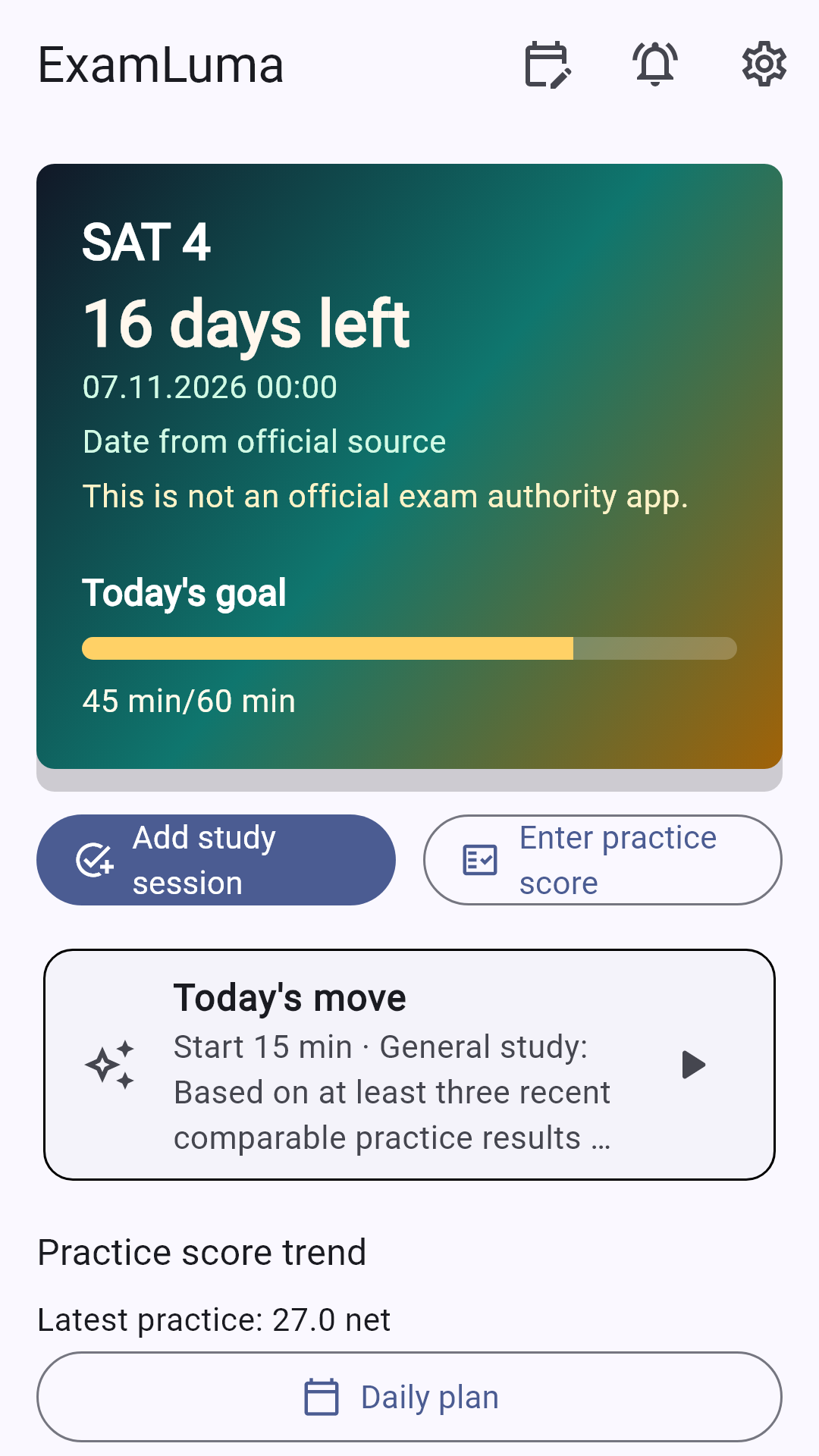
Set your daily study-time goal in ExamLuma and start a focus session whenever you sit down for a retrieval block. Every completed session records time directly to your chosen subject, and logging your practice-test records lets you see your consistency across your weekly statistics.
How ExamLuma helps
Keep track of your study plan in ExamLuma. ↗
Set a daily study goal and follow your progress. ↗
Record completed study sessions. ↗
Frequently asked questions
How does spaced review differ from cramming a single SAT topic?
Spaced review returns to a skill such as linear equations on separate days. At each return, recall the method first, solve a question, and compare your steps with the explanation. Keep a note of the step you want to revisit.
What should I do before opening my notes during a review session?
Start by solving a fresh problem or writing down the core rule from memory before looking at any explanations. Testing yourself first shows you exactly which step or transition pattern still feels shaky.
How do I pair worked examples with independent problem solving?
Study a complete step-by-step solution to see how the concept operates, then close the explanation and solve a parallel question on your own. Explaining why each step works helps you apply the method when the test changes the context.
How does ExamLuma help me keep my review sessions consistent?
You set your daily study-time goal and run a focus timer for each SAT subject block. When you finish, the completed time is recorded to that subject so you can check your weekly statistics and practice-test records in one place.
Sources
- Organizing Instruction and Study to Improve Student Learning · Institute of Education Sciences · 2007
- Build Your SAT Suite Study Plan · College Board
- The Reading and Writing Section · College Board
- The Math Section · College Board