How to Create an SAT Study Schedule From Practice Results
An effective SAT study schedule starts with your latest Bluebook diagnostic results and your actual free hours. By matching missed skills in Reading and Writing or Math to open study blocks, you turn practice insights into steady daily action, record focus time in ExamLuma, and adjust your priorities.
Last updated:
Starting your SAT preparation with a clear calendar saves energy and keeps every study session focused on the skills you have chosen to practice. Instead of copying a generic routine, shape your week around what your latest diagnostic reveals and the hours you genuinely have open.
Turn diagnostic insights into weekly priorities
Inspect missed questions and personal pacing notes
Begin by opening College Board’s My Practice portal to examine your Bluebook practice results and read the explanations for every answer choice. Pair those explanations with the personal notes you wrote during the test about lucky guesses and slow questions. As College Board’s study planning guide recommends, checking why you missed each item alongside your available time helps you pick study activities that fit your routine.
Balance Reading and Writing with Math domains
Group your flagged items into test areas so each block has a clear target. According to College Board’s Reading and Writing overview, verbal questions cover Information and Ideas, Craft and Structure, Expression of Ideas, and Standard English Conventions such as sentence boundaries. On the quantitative side, College Board’s Math overview covers Algebra, Advanced Math, Problem-Solving and Data Analysis, and Geometry and Trigonometry. For an Algebra block, name the equation setup you will practice. For a sentence-boundary block, write the punctuation decision you will explain before checking the answer.
Map your actual free pockets before assigning tasks
Mark your fixed school and family commitments first, then place targeted practice into the open windows. To organize those sessions well, the IES study guide recommends spacing learning across days, alternating worked examples with independent problem solving, taking retrieval quizzes, identifying skill gaps, and asking explanatory questions. Lay out your open afternoon and weekend slots in the printable weekly study planner and pair your routine with the broader strategy in our SAT preparation guide as you assign specific domains to each day.
Sample plan: 7-day SAT study schedule
This 7-day schedule turns diagnostic notes on linear equations and sentence boundaries into concrete daily blocks:
- Monday (45 minutes): Algebra — study 4 worked examples on linear equations, solve 8 independent problems, and write why each step works.
- Tuesday (40 minutes): Standard English Conventions — analyze 10 sentence-boundary items, reading the explanations for all 4 choices per question.
- Wednesday (45 minutes): Problem-Solving and Data Analysis — complete 10 ratio problems, writing scratch setups before testing 5 items in Desmos.
- Thursday (35 minutes): Information and Ideas — take a 10-question retrieval quiz on central ideas and log slow items in your notes.
- Friday (45 minutes): Advanced Math — alternate 3 worked examples on quadratic functions with 9 independent problems, then revisit Monday’s Algebra notes for 10 minutes.
- Saturday (60 minutes): Mixed timed set — complete 15 Math and 15 Reading and Writing practice questions from your study resources; record slow items in your own notes for the review block.
- Sunday (30 minutes): Weekly adjustment — compare Saturday’s accuracy with Monday’s notes and assign the next 7 days of priority topics.
Keep your schedule moving with ExamLuma
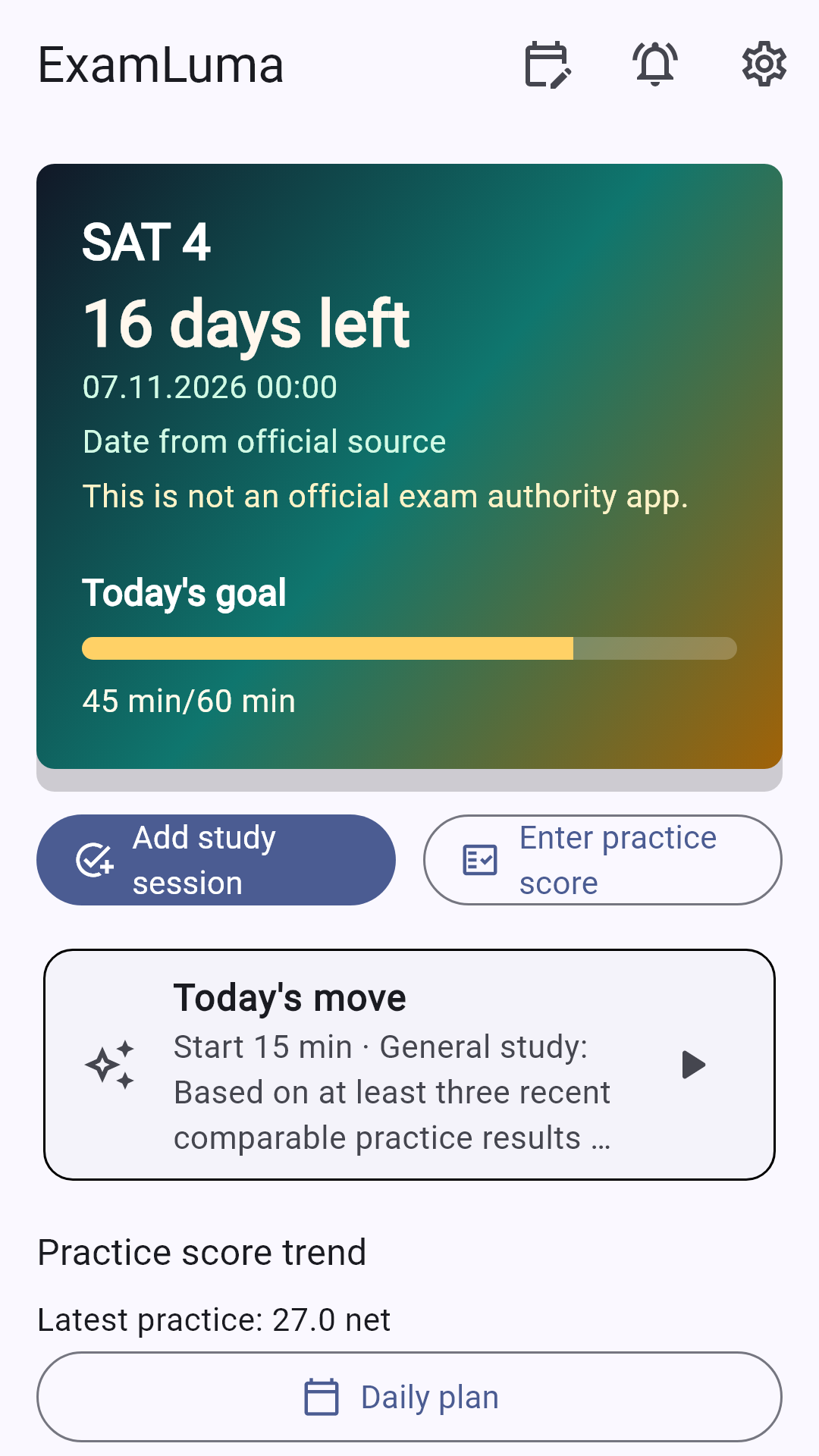
Once your local schedule is ready, open ExamLuma to set your daily study-time goal and run a focus timer for each block. Completed focus sessions are recorded by subject, and your weekly statistics show how steadily you meet your time targets alongside your saved practice-test records.
How ExamLuma helps
Keep track of your study plan in ExamLuma. ↗
Set a daily study goal and follow your progress. ↗
Record completed study sessions. ↗
Frequently asked questions
How do I decide which SAT topics to schedule first?
Start with the domains where your Bluebook results and personal notes show repeated errors or slow pacing. Select a concrete task such as setting up a linear equation or explaining a sentence boundary, then reserve time to check your solution.
Why should I check explanations for every answer choice in My Practice?
Reading the explanation for both the right option and the distractors reveals the exact reasoning trap behind an error, helping you pick targeted practice tasks for your next study session.
How can I use the printable planner alongside ExamLuma?
Lay out your open weekly time slots and specific SAT topic tasks on the printable planner at your desk, then use ExamLuma on your phone to set daily study-time goals, run subject focus timers, and check your weekly statistics.
When should I adjust my weekly SAT study schedule?
Update your topic priorities after completing a fresh practice set and comparing your latest accuracy and pacing notes against earlier sessions, moving stronger skills into spaced retrieval blocks while giving remaining gaps fresh attention.
Sources
- Organizing Instruction and Study to Improve Student Learning · Institute of Education Sciences · 2007
- Build Your SAT Suite Study Plan · College Board
- My Practice 101 · College Board
- The Reading and Writing Section · College Board
- The Math Section · College Board
- SAT Suite Calculator Policy · College Board