JLPT Scores: Scale, Section Minimums and Pass Rules
A JLPT result is a scaled score report derived from response patterns rather than a simple correct-answer count. Passing requires the published total mark and every required scoring-section minimum. The report structure changes between the upper and lower levels, so identify your level before comparing totals, section profiles or practice results.

Last updated:
The JLPT exam guide explains preparation, while this page explains the official result. Start by confirming the level on the score report. The same total range appears across levels, and the composition of scoring sections changes between the upper and lower groups.
Recognise a scaled score
JLPT reports a scaled result rather than a simple sum of correct answers. The official JLPT FAQ explains that the score is calculated with Item Response Theory. This method reflects response patterns and item characteristics, making an online “points per question” table unsuitable for reproducing the official result.
Use raw correct-answer counts for practice diagnosis. They can show whether vocabulary, reading speed or listening detail deserves attention. For applications and official comparison, use the scaled values printed on the result notice.
Identify the scoring sections for your level
Every JLPT level uses a total scale of 0–180. For N1, N2 and N3, the report has three scoring sections: Language Knowledge at 0–60, Reading at 0–60 and Listening at 0–60. The official result guide publishes these ranges and labels. Keep all three values visible when reviewing an upper-level result, because a similar total can contain a very different language profile.
For N4 and N5, Language Knowledge and Reading form one 0–120 scoring section, while Listening is reported at 0–60. The same official guide shows this lower-level structure. Compare results only within the matching level structure.
Apply both pass conditions
The official total passing marks are 100 for N1, 90 for N2, 95 for N3, 90 for N4 and 80 for N5. The JLPT pass table lists each value. Reaching the total is the first condition.
For N1, N2 and N3, every 0–60 scoring section must also reach 19. For N4 and N5, the combined 0–120 section must reach 38 and Listening must reach 19. The official section-minimum table states these thresholds. Each section minimum remains compulsory alongside the total mark.
A missed required test section leads to an unsuccessful result, and the report leaves numerical fields blank even for completed sections. This rule appears in the official results guidance. Treat a blank numerical field as a participation issue rather than a low section score.
Read the CEFR reference separately
From the 2025-12 JLPT, a CEFR reference appears only for candidates who pass. The official mapping is N5 80 or higher = A1; N4 90 or higher = A2; N3 95–103 = A2 and 104 or higher = B1; N2 90–111 = B1 and 112 or higher = B2; N1 100–141 = B2 and 142 or higher = C1. The JLPT CEFR reference page publishes these bands. It covers linguistic competence and reception measured by JLPT; speaking, writing and interaction sit outside this reference.
Match the result to its purpose
A pass certifies that the official total and sectional conditions for that level were met. The JLPT certificate remains valid indefinitely, while a school, employer or licensing body can set its own recency rule. The official JLPT FAQ separates certificate validity from an institution’s acceptance policy. Record the required level, test date and document deadline from the receiving organisation’s current page.
To plan your next practice cycle, move from the lowest scoring section to the tasks behind it. Language Knowledge may call for recognition and use of vocabulary or grammar; Reading may require structure, reference or inference work; Listening may require detail, speaker intention or pacing. Test the selected change with fresh material.
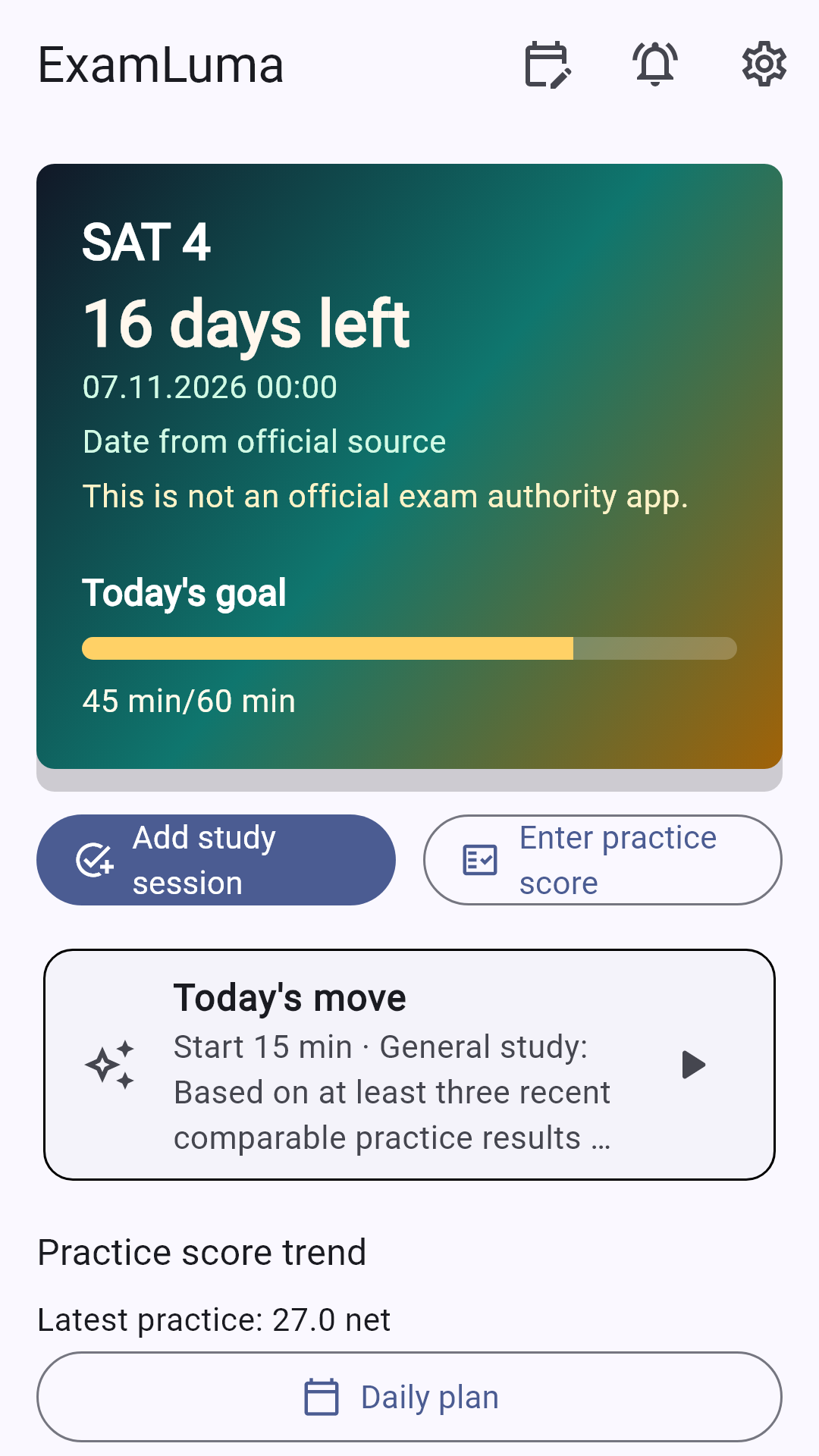
ExamLuma lets you select JLPT as your target exam, view the countdown, set a daily study-time goal and use the focus timer. After a practice set, enter your result yourself to follow the overall trend and weekly study statistics, then use the practice-test review guide to schedule the section task identified in your review.
How ExamLuma helps
Keep track of your study plan in ExamLuma. ↗
Set a daily study goal and follow your progress. ↗
Record completed study sessions. ↗
Frequently asked questions
Is the JLPT score the same as my number of correct answers?
The official test reports a scaled result based on response patterns. Use raw answer counts for practice diagnosis and the official report for formal comparison.
Can a high total compensate for one weak section?
Both conditions remain compulsory: the total passing mark and every applicable scoring-section minimum.
Why does the report structure differ by level?
The upper levels report three scoring sections, while the lower levels combine language knowledge and reading into one scoring section.
What should I compare between attempts?
Compare the same level, total scale and scoring sections, then connect each weak section to the underlying question types in your review.
Sources
- JLPT Scoring Sections and Pass or Fail Determination · Japan Foundation and Japan Educational Exchanges and Services
- JLPT FAQ on Scaled Scores · Japan Foundation and Japan Educational Exchanges and Services
- JLPT CEFR Reference Indication · Japan Foundation and Japan Educational Exchanges and Services